
And this would be all part of why I often put educational stuff on Samizdata rather than here, this being an Instalink to this.
I probably should have said something about this there as well, instead of merely here (see post immediately below here). But Perry de Havilland has now mentioned it.
A commenter named Kelli, who I assume to be English, has already asked about "homeschooling libertarians". Please go there and answer her if you can. As usual, the message here is: do read the Samizdata comments, and of course join in, because you too can then enjoy that big readership, now running at about 6,500 per day, Perry tells me. But do it quick, because Samizdata is a high turnover blog and stories fade from view fast. Some Samizdata comments are inane, of course, but I have already learned a lot about the whole Spanish language in the USA argument, from the comments on the Spelling Bee posting.
Getting back to that BBC report about Home Education harassment, I can find no further mentions today (although my searching skills are not stellar) in the three British broadsheets I regularly link to (Guardian, Telegraph, Indy) about this latest menace to Home Education.

I have a busy afternoon ahead of me, preparing for my Brian's Last Friday meeting tonight, but Julius Blumfeld, to whom thanks, has just emailed me with the link to this, from the BBC:
Some parents claim they are educating their children at home to hide the fact they are abusing them, welfare officers say.The Association for Education Welfare Management has asked the Children's Minister, Margaret Hodge, for the power to check up on home educators.
It says the forthcoming Children's Bill is a good opportunity to change the current practice.
Home educators regard the move as offensive and unnecessary.
It was only a matter of time. Just what will this "checking up" end up amounting to, I wonder?
Let me see if I can quickly dig out a posting here of me prophecying that something along these lines would be happening some time soon.
Well, how about this? - not from me but from Julius, on January 16th 2003:
Yet as more parents home educate their children, it will become increasingly visible. And as that happens, the pressure will grow for the State to "do something" about "the problem" of home education. The pressure will come from the teaching unions (whose monopoly it threatens). It will come from the Department of Education (always on the lookout for a new "initiative"). It will come from the Press (all it will take is one scare story about a home educated ten year old who hasn't yet learned to read). And it will come from Brussels (home education is illegal in many European countries so why should it be legal here?).
Not bad.
The pattern is the same with home education as it is with everything else. Something goes wrong, in the context of harmless, legal activity X. Therefore everyone – not just wrongdoers but everyone – doing X gets screwed around from now until the End of Time by the government.
Child abuse is already illegal. The way to stop it is to punish it as and when it is detected. The way to detect it is for neighbours to keep an eye and an ear out for it. The idea that harassing people like Julius Blumfeld and his family is going to improve anything except the salaries of the harassing classes is absurd.
The other day I had one of those deeply satisfying conversations where someone says to you that (a) you said something very memorable to them several years ago which you had yourself completely forgotten about, and that (b) it had proved to be invaluably useful advice. So, hurrah for me.
Apparently I had said something about visualisation to this friend of mine, and it had worked, and helped her to do really well at university. So, I might as well pass it on to all you millions of people who read this. I say it to a lot of people because it is true true, and it is valuable, even if (as I will shortly explain) you have heard it several times before.
The basic point here is very simple: visualisation works.
Suppose you have acquired an ambition, but think of yourself as being someone who "lacks willpower". Suppose, that is, that you often "tell yourself" to do this or that, but then never seem to get around to doing it.
Assuming that you do sincerely want to do whatever it is, the way to get yourself to do something is to imagine yourself already doing it.
Apparently, what I told my friend the university student was: if you are worried about not getting stuck into your university work the way you now want to, the way to do that is to picture yourself doing this work in exactly the way you want to do it. Imagine yourself sitting at your desk in your room, deep into your books, scribbling pertinent notes. Imagine yourself getting tired, taking a breather from work, and then going right back to it half an hour later. In general, picture yourself living and working the way you want to.
And here's the really interesting bit. That's all you have to do. The actual result will then come automatically. If you have never done this, or never done it self-consciously, realising that you were doing it, so to speak, you might suppose that this is some kind of voodoo psychobabble. But it isn't. It works. Picutre yourself doing whatever it is, and then a few days, weeks, months or years later (depending on what kind of task it is) you will realise that, by God, you did exactly what you imagined!
It even works for things which you would think would require all sorts of impoossible-to-guarantee inputs from other people. This is because we all of us actually have lots of bits of good luck, every day of our lives. The trick for living successfully is to programme your mind to take advantage of these lucky breaks, saying and doing, immediately, without thinking about it, exactly what you need to say and do to make maximum use of all the luck that comes your way.
So, imagine yourself having that job interview. Imagine yourself saying all the things you want to say, in exactly the confident yet un-annoying way you want to say them. Imagine the people who are interviewing you saying the things you want them to say. Sooner or later, you – that is to say your subconscious mind – will manoevre yourself into circumstances where all of this happens for real.
Imagine the big things you want to do with your entire life. Picture them, as if you were starring in a movie. Imagine the tiny things you want to get done tomorrow morning. Imagine everything in between. Imagine it, and then forget about it and just do what comes naturally. Then sit down, relax, and imagine it again. What will come naturally is what you have imagined.
Well, not automatically. You could be hit by a car tomorrow morning and die in agony. (Don't picture that for any longer than you have to.) But visualisation will increase your chances of getting what you want.
(Talking of cars knocking you down ... if you picture what you fear, your mind will go after that too. So don't do this. Imaginative aversion therapy, so to speak, doesn't work.)
What does not work is to berate yourself with merely verbal instructions. Verbal instructions (items on on a verbal list for instance) are very useful, but not on their own. The words have to be the captions to pictures. They have to trigger the pictures. Then, they'll work. On their own ("willpower") they won't work.
I've tried this stuff on myself, and every time I try it, it gets results. I told my university friend some of this, and it worked. It does work. The value of this posting is not that you are likely to be hearing this for the first time in your life, although I suppose that this is just about possible. No, the value of this post is that you are hearing yet again from yet another person that visualisation works.
Make it work for you.
I was never told any of this when I was at school, which in retrospect I find rather surprising. I had to read about it in American psychobabble books, which are often not any sort of babble whatever, of course. Why wasn't I told about it sooner? Perhaps because until I was about twenty what I personally wanted to accomplish wasn't the central agenda of my life. (Maybe I was told about it, but I wasn't listening.) I was just doing what was expected of me, or rather what I supposed others to be expecting of me. And I've never been much good at that. But I digress.
Central point here: it works.
This is one of the reasons why I like the idea of putting pictures up on this blog from time to time, as on my other one. Picturing things is very powerful.
It's not that I'm against words. But words work best if they conjure up pictures. I haven't put up any picture with this posting, because the point is: what is the picture that you want? Add it for yourself, in your own mind.
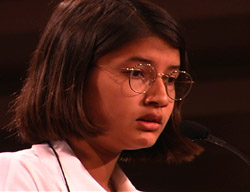 I have just done a posting for Samizdata provoked by the movie Spellbound. No that's not the Hitchcock one. It's about something they have in American called a Spelling Bee, and if you want to know why Bee? – well, the answer to that has already materialised in the comments section there. Comments also look as if they will pile up on the vexed question of the Spanish Language versus the English Language in the hitherto reasonably united United States of America, at any rate since it was last disunited at the time of the Civil War.
A question I also asked, but have so far not got any answers to, although it's early hours yet, is: do we have anything like Spelling Bees here in Britain, and if not why not?
I think the time is ripe for a national juvenile spelling competition, perhaps organised by a TV company. Not only would this encourage the art of spelling, at a time when many fear that it may be being lost irretrievably and descending into a pre-Shakespearian chaos. It would also do what Spelling Bees have long done in the USA, namely draw the children of immigrants into the national indigenous culture, and enable them to make an early mark on it that is not based on being a criminal, or a mere athlete. (I say "mere" athlete, because athletic success often smuggles in a subtext of "good at running but no brains". The trouble with things like brain surgery is that they take so much longer to make your mark in.) Spelling Bees would challenge that stereotype, but just like sport, the rules of the game would be utterly objective and hence ideal for ethnic minorities who are on the receiving end of racist attitudes in other more complex competitive arenas, or who merely fear that they are.
UPDATE Friday 27th 5pm: the comments on the Samizdata version of this have been trickling in at a nice rate, and are well worth reading - 23 so far.
I'm watching former Cabinet Minister ("Overseas Development" I think she was) Clare Short pretending to be a teacher, in one of these unreal reality TV shows. She starts, poor thing, by thinking that she'll be teaching, when in fact her basic job is child minding and power projection. Child domination in other words. She keeps using the word "please", which is not good news coming out of the mouth of a prison officer.
Her basic problem is that she is in the middle of a hierarchy, and she has a problem with authority. She has a problem with the authority of her superiors (whom she keeps reminding are only pretend superiors, for a week, and generally patronising and refusing to listen to) and even more she has a problem with her own authority. She is in a school and her job is to keep the inmates under control. She is becoming a bossy cow in front of our eyes, being a bossy cow being her job.
I'm torn at this stage between thinking that Clare Short has a point, and that she is a silly cow. As a senior politician, and a Labour one at that, she has been presiding over this system of command and control. Did she think that it could ever be this inspiring utopia that she wants to operate in?
On the other hand, she's just given a talking-to to a young boy which might actually have made some sense to him, and made him into a better person.
And now, there's what looks like a completely pointless mass expedition into the car park by thirty children, and this bossy little git is telling them all with maximum officiousness - and effectiveness, given what he's trying to achieve, which is power over everybody - about what they all "need" to do. But what I would "need" if I was trapped in this insanity would be something not insane and not ridiculous. Now Clare is in charge of this lunacy, and of course, her not being a trained prison officer, it all gets out of control. The prisoners don't do their tasks. Clare starts to beg them to do what the system wants, but why should they?
I'm torn between thinking that Clare Short is ridiculous, and thinking that she is actually quite sensible but that what she is doing is ridiculous.
Now her tutor group are "not cooperating". "Please", she keeps saying.
Please behave like good prisoners. Please stop behaving like bad prisoners.
Oh dear. Now she's making her group give us her Third World propaganda pitch. We Brits ought to moan less and: "We want justice for developing countries!" shouts one of them. Applause. Her superiors are very impressed. They don't care about the Third World. What they care about is that Clare has got her little set of poodles performing like performing poodles. Oh well, better that than wolves devouring each other.
It wouldn't take long for Clare Short to fit right in and become an expert childminder/power projector. She's obviously getting the hang of it. She's learning to give orders with words like "Would you like to …" at the start of them, but in a tone of voice which actually says "I order you to …"
Yes. She's cracked it. And her superiors are exultant. They've converted her.
Interesting programme. I basically agree with the teachers, which is that if you have compulsory school attendance, this is how it has to be done. You can't force people to attend a place like this, and then pretend, and make them pretend, that it is all voluntary. Better to be honest about what is going on. Yes miss, no miss, three bags full miss. This was a "good" school. Poodles and not wolves.
But I now feel the way Clare Short felt at the start. It ought to be possible to do better than this.
I already have a word for this. Sovietisation:
Having taught GCSE since the exam was introduced 15 years ago, I have become convinced that the coursework element of it is a national scandal. I think people outside the profession would be aghast if they knew how widely abused it is.For the past 10 years I have been head of the modern languages department in an ordinary comprehensive with 1,000 pupils. Many of them are well-motivated children with supportive parents, but we have our share of disadvantaged and disaffected youngsters. Thanks to the commitment and hard work of the staff, our GCSE pass rate has been improving steadily.
League tables compare the performance of one school against another. The same sort of comparisons are made between parallel classes in the same school. So the onus is on teachers to do all they can to maximise their pupils' marks. One aspect of that is ensuring that every piece of coursework is of the highest possible standard.
If a pupil hands in a piece of work that you feel he could not possibly have done on his own, the days are long gone when integrity and honour would have obliged you to question it. If the work is sub-standard, you help the pupil to beef it up. And then, of course, what you do for one, you must do for the others.
This used to be called cheating. Now, it's the job.
Concluding paragraphs:
The consequence is that our pupils achieve a higher mark for their writing than for all the other parts of the exam, even though it is the hardest element. This is never queried by the GCSE board. Why should it be? It is the same in every other school because - I can only assume - my colleagues are also giving their pupils lists of phrases and sentences to use.When all the written work is complete, the pupils sign a declaration that it is their own work. The declaration is counter-signed by the teacher, with emotions that can easily be imagined.
The truth is that coursework cannot be policed in such a way that teachers do not succumb to pressure to manipulate the results. I believe it is time to put an end to the scandal. Let teachers teach. Don't put them in the position of having to do the exams as well.
Every year the government asks the teachers: how are you doing? And every year the teachers reply: better and better. A steady improvement.
The real killer punch in this story is that the government itself knows that this is what is really going on. How could they not?
But why would they want to admit that their policies aren't working as well as they've been saying? That's the really "soviet" bit.
The teachers aren't the only ones bending the rules.
I do not yet have any idea what to think about this, other than to suspect that whatever the government does, it won't make that much difference:
Maths education is failing on every account and needs a fundamental multi-million pound overhaul, a government-backed review of the subject reported today.The current system of GCSEs and A-levels is not meeting the needs of students, teachers, employers or universities, the report's author, Professor Adrian Smith, said today as he published the damning 186-page document, the result of a 15-month inquiry into the future of maths in schools.
Less than 10% of GCSE students go on to take A-level maths, and less than 10% of A-level students go on to a maths degree, the report says. Incentives should be considered to halt the "disastrous" decline in pupils taking maths at A-level - examples mooted include waiving university tuition fees for maths students.
Further incentives are necessary to recruit and retain more maths teachers. The report documents a shortfall of 3,400 qualified maths teachers - 40% of maths graduates would have to become teachers to account for the shortfall.
GCSE maths should be split into a two-tier structure covering "maths for life" and maths for further academic study to ensure pupils at both ends of the ability range are properly stretched.
The report calls on the government to set up a "maths tsar" to help revamp the structure and content of the maths curriculum and also to advise ministers.
Ah, a tsar. That's the giveaway. What they appoint a tsar, it means they don't know what the hell to do, and are praying for a miracle.
I suspect that this may be more than a mere error of British education policy, and more like a fundamental historical shift, away from making things, and towards supplying those aesthetic services that Virginia Postrel goes on about. After all, how much maths do you need to be a beautician? Or a lawyer?
If all that physical stuff that the West used to churn out is now going to be made in China, it makes sense for young people to shift their focus away from hard science and towards soft philosophising and grooming and chit-chatting. counselling, marketing, packaging, advertising, showbiz, coming first in reality TV contests. That does certainly seem to be the direction of the culture (and I am certainly in no position to complain about it). And against all that, as I say, I suspect that the government may be powerless.
My thanks to Andy Duncan of Samizdata for noticing that Britain's academics are, apparently, about to go on strike. Unless of course their employers back down in terror at their threat.
Now if I was a betting man, and had to guess the contingent of British society which still possessed the highest percentage of Marxoid buffoons, after the disastrous collapse of Marxism in Eastern Europe, I'm sure you wouldn't give me tremendous odds against it being University lecturers.But what's really amusing is that they still think anyone at all, outside the ivory tower, cares enough about them to quake in their boots, at their threat of a three hour strike. Well, I've got some news for you dear Marxoid professors. The nation ain't going to be paralysed. Indeed, it's barely going to register at 0.001 on the Richter Scale. Worse than that, it's barely going to register at 0.001 on the Newcastle Brown Ale Scale, on your own campuses. Mine's a large one, and a deep-fried Pizza, please, stout yeoman of the bar.
Yeah. Ha ha. And indeed, if it's "humanities" lecturers and the like, then forget it. The nation will be able to endure being thus held to ransom indefinitely. But surely some university lecturers are actually doing valuable work, which their students appreciate and might actually miss. I can imagine some students and hence some universities actually wanting some lecturers to go back to work at once.
If this strike stimulates a national debate about which lecturers will actually be missed, and how much they will be missed, it will have done British higher education a great favour.
But as for those post-modernist literary wafflers, who have been telling themselves how essential they are for so long that some of them may even believe it, they are perhaps about to get a rude shock. Most people despise them, and would be happy for them to remain on strike for ever. Certainly I do and I would. I seriously doubt if they are so severely stupid as to expose themselves to this kind of public derision, but you never know your luck. Maybe some of them are that daft, and will make prize asses of themselves on Newsnight in the days to come. If I witness any such foolishnesses, I'll let you know.
More seriously, I think this is very good news. It signals that British universities are a-changing, and in a good way. Some lecturers are going to get paid more, and others less, and the lumpen mass of them is frightened.
As I say, good.