
I hesitate to say for sure, because you never really know with mere news reports, but on the face of it, this is absurd, and guaranteed to make it massively harder for schools to maintain discipline.
Politicians and education bosses today defended controversial plans to penalise schools by up to £10,000 if they expel a pupil.They warned that the money to teach permanently excluded children had to come from somewhere and, if penalties were not introduced, it might have to be found by cuts to school budgets.
The city's education authority is proposing the penalties in a discussion document which has drawn an angry response from teachers and union officials.
Head teachers who have spoken to the Leicester Mercury accept that if they exclude a child the school should pay back the money it received to teach them - £3,149 on average for a secondary school pupil.
However, they are unhappy with the idea that they should be penalised extra money - up to £10,000 for a child who has special educational needs such as behavioural problems.
It is not a bit clear to me that they should have to pay that £3,149 back again, let alone another £6,851 on top of that. After all they did teach the child, and presumably whoever was in charge of the child wanted the child to go on being taught there, or there wouldn't be all this grief about the child being expelled. As for being fined (equals semi-compelled) to teach absolutely anyone who goes to their school (special "needs" – God how I hate that word), no matter how indifferent, hostile or violent that child may be about it, that just seems to me to be wicked, and not in a good way.
If teachers are forbidden to use violence, and they are, and if as well as that they are forbidden to expel or exclude, they are simply at the mercy of any pupil who or consortium of pupils which decides to misbehave, as are all the pupils at the school who actually want to do some learning.

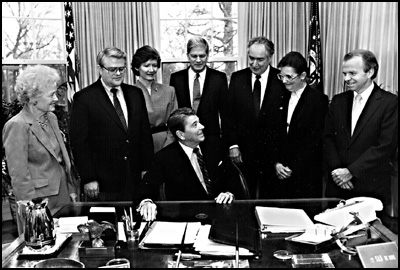
Ronald Reagan's funeral is today. Here's an intriguing educational titbit from his Autobiography:
Another newcomer in Dixon that year was a new English teacher, B. J. Frazer, a small man with spectacles almost as thick as mine who taught me things about acting that stayed with me for the rest of my life.
Our English teachers until then had graded student essays solely for spelling and grammar, without any consideration for their content. B. J. Frazer announced he was going to base his grades in part on the originality of our essays. That prodded me to be imaginative with my essays; before long he was asking me to read some of my essays to the class, and when I started getting a few laughs, I began writing them with the intention of entertaining the class. I got more laughs and realized I enjoyed it as much as I had those readings at church. For a teenager still carrying around some old feelings of insecurity, the reaction of my classmates was more music to my ears.
Probably because of this experience and memories of the fun that I'd had giving readings to my mother's group, I tried out for a student play directed by Frazer – and then another. By the time I was a senior, I was so addicted to student theatrical productions that you couldn't keep me out of them.
Prior to Frazer's arrival in Dixon, our high school's dramatic productions had been a little like my mother's readings: Students acted out portions of classic plays or out-of-date melodramas. B. J. Frazer staged complete plays using scripts from recent Broadway hits and he took it all quite seriously. In fact, for a high school English teacher in the middle of rural Illinois, he was amazingly astute about the theater and gave a lot of thought to what acting was all about. He wouldn't order you to memorize your lines and say: "Read it this way ..." Instead, he'd teach us that it was important to analyze our characters and think like them in ways that helped us be that person while we were on stage.
During a rehearsal, he'd sometimes interrupt gently and say: "What do you think your character means with that line? Why do you think he would say that?" Often, his questioning made you realize that you hadn't tried hard enough to get under the skin of your character so you could understand his motivations. After a while, whenever I read a new script, I'd automatically try first to understand what made that particular human being tick by trying to put myself in his place. The process, called empathy, is not bad training for someone who goes into politics (or any other calling). By developing a knack for putting yourself in someone else's shoes, it helps you relate better to others and perhaps understand why they think as they do, even though they come from a background much different from yours.
It seems that cheating is getting easier.
But be warned. If you do it, they'll take your money and only fail you at the eleventh hour.
Here is a report on the next chapter in this horrible story:
A German court yesterday jailed the teenage ringleaders in a class of students that tortured a schoolmate for months and posted film clips of the abuse on the internet.
Good.
This is mind-boggling. Like RC Dean, I hardly know where to begin, so I won't. Suffice it to say that, at any rate in some parts of the USA, you are now, as a parent, expected to boggle the mind of your offspring.
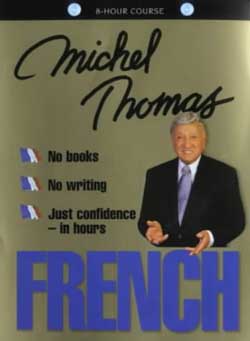 I've made a start with these CDs.
Reactions.
I am not completely convinced by his accent, and it is vital, when learning something, to believe in the veracity of the material being presented. Next time I meet a real Frenchman, I will listen to particular things very carefully, and ask for clarification on certain points. I suspect Michel Thomas of having spent his time in France in the south of France. Maybe that's the difference.
I didn't know that it is necessary to emphasise the last syllable of a French word, or risk incomprehensibility. I assume he's right about that. But again, it sounded vaguely south of France rather than France as a whole. But I presume him to be right about that.
But, those few quibbles aside, I am very impressed. So far I have listened to about half of the first CD, there being eight CDs in all. So, early days, and maybe later I'll want to revise some of what follows. Nevertheless, for the time being …
The most interesting thing about the Michel Thomas teaching method is that everything he does is done the way it is done in order to keep the victim relaxed, i.e. for the victim not to be a victim. Whenever a pupil (a much better word) hesitates or gets it wrong, he corrects them, without implying any blame. Indeed, he starts not by pitching right into teaching, but by saying that his method of teaching places the responsibility for the pupil learning on the teacher, rather than on the pupil, and that the pupil has to be relaxed, and not worrying, either about these French lessons or about anything else. The only thing that the pupil has to do is relax, listen and keep on listening, and to join in with the answers as required. He mustn't do homework, or take notes, or make any effort to remember things.
The presentational method of the CDs is to have a couple of pupils responding to Thomas' instructions, exactly as he wants you to respond. Every so often there is a bleep noise, at which point you must hold the pause button down and say the answer, and then resume, and see if you got it right. Usually, you did. Because he just told you the answer a moment ago.
There is no bullshit here about how there is no such thing as teaching, only learning. Michel Thomas is a teacher, and he is very clear about that.
Because of the presence of pupils, these CDs serve not only as lessons in the subject being taught, but also as lessons in how to teach (by which I simply mean the technique for transferring knowledge from mind A to mind B), which for me made them doubly valuable.
The most interesting feature of all of this "keep them relaxed" method is that not only does Thomas almost never criticise (he did a tiny bit when he told a pupil not to guess); he also goes very easy on the praise. What matters to him is the continuity of the learning process, learning being its own reward. You are pleased not because Michel Thomas says how wonderful you are, but because you have learned a lot of stuff and are getting answers right.
Thomas is teaching not just French as such, but French to people who already know English, and he makes use of the enormous overlap between the two languages, so pronounced (as it were – actually pronounced a bit differently) that one ancient French guy whose name I have forgotten said that English is just French badly pronounced. Any English words ending in –ation or -ary, for example, are actually French words, and you already know them. Interesting, and enlightening, but of course that kind of method wouldn't work for English people learning Chinese or somethiong.
It also occurs to me that the Michel Thomas method is actually quite "mechanical", in that Michel Thomas himself could do it to a new pupil pretty much automatically. This says two things to me. First, it explains Michel Thomas' enormous, all-embracing confidence in his ability to teach, say, French, to anyone. Teaching French to someone new whom he has only just met is, for him, no harder than doing up his own shoe laces, and, simply, he knows how to do it. I thought I knew that stuff about "teacher expectations", but believe me, until you've sampled Thomas, you have never experienced unconditional and total teacher confidence to compare. Thomas made his judgement of you and decided on his expectations of you right at the start. You are a human, and you have one of those human brain things between your ears. Ergo, given that he knows how to teach it, you will learn it. It is that simple.
And second, the mechanical nature of the method means that it ought to be extremely easy to put it all onto a computer, and make it part of the repertoire of a teaching machine. But that's a different line of thought.
One caveat though. In addition to knowing my regular quota of English French words, I already know quite a lot of French French, having done French at school for quite a while, and having then visited France a number of times. In order to really judge Michel Thomas' excellence as a teacher, I really ought to try some other language of which I now know nothing or next to nothing. When I'm done with the French CDs, I might just do that.
I saw this article in the Telegraph several days ago, but then failed to find it at the Telegraph site. Now I have found it, whether because it has only just appeared, or because it was there all along and I only just found where, I do not know.
Anyway, it is very well worth reading. Madsen Pirie has a different take to the usual right wing buffer position on the private sector, reported on in the Telegraph piece that his piece links to:
Independent schools are too expensive for most people; they provide a service that is bought by only seven per cent of the population. Yet polls have shown repeatedly that most of us would like to send our children to an independent school if only we could afford it.One of the reasons for their high cost derives, paradoxically, from their charitable status. If they were profit-making companies that distributed their profits to shareholders, there would be incentives for them to keep costs down and operate efficiently. They would try to sustain dividends and share values by seeking savings.
The schools' charitable status has the perverse effect of encouraging them to plough any surpluses into yet more capital investment in facilities and equipment. Money that a private firm would distribute is instead put towards a new library, sports hall or information technology centre.
These additional facilities can be justified as extra selling points. They make the school more attractive to potential customers. The glossy brochure highlights the extra amenities as a competitive advantage, giving the school an edge over its rivals. A school that fails to add a modern science laboratory or an IT centre risks losing potential pupils to those that do. One headteacher recently compared this to an arms race in which schools spend on ever more expensive facilities simply to stay abreast of their rivals.
Let's be clear that it is not the idea of charity as such which is doing the damage here, but the concept of Charitable Status, and what it forbids you to do.
Concluding two paragraphs:
Several educational entrepreneurs are now talking in terms of new private schools that would charge fees not very different from the costs of a state education. The Conservative Party's "school passports" would allow parents to choose such schools as alternatives to their local state schools. These schools would come without the centuries of tradition or the luxurious facilities, but they would offer a high quality education at an affordable price. There could be chains of successful schools reproducing the winning formula and management methods that bring results.The future of private education may well be one of diversity of products and prices. There will still be luxury private schools at the top end of the market, as there is still British Airways first class travel. But just as easyJet and Ryanair have brought the joys of flight to many more people than could afford it before, so it may be time for new types of fee-paying school to spread the benefits of private education to a wider public.
Presumably Madsen has this kind of thing in mind.
It's gratuitous picture time! I snapped it today, in London.
Here's the story:
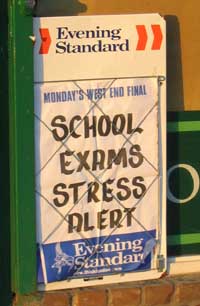
Exam stress has become so serious that government health advisers are to issue guidelines to doctors on coping with severe cases.The National Institute for Clinical Excellence (Nice) will set out the best way to treat teenagers suffering from depression triggered by exam pressures. GPs will be guided on whether to prescribe counselling, psychotherapy or anti-depressant drugs.
I find this extremely depressing. So do I need counselling, psychotherapy or anti-depressant drugs?
Hello. It sounds as if they're having problems with exam cheating in China.
I always interpret announcements that they're going to jolly well do something about stopping whatever it is as the proof that whatever it is is happening but not necessarily that whatever it is will be stopped.
So this tells me something, but not what Vice Minister of Education Yan Guiren wants to tell me:
Vice Minister of Education Yuan Guiren on Saturday pledged that great efforts would be made to prevent any kinds of fraudulent practices in coming university entrance examination, which will be held from June 7 to 9.Yuan said this year saw the largest number of university entrance examinees since the exam was resumed in 1977 after the 10-year-long "Cultural Revolution". All relevant departments must strengthen exam discipline and resolutely crack down on any forms of exam corruption.
He pledged that severe punishment will be imposed on three types of exam cheating, including finding scapegoat to attend exam, sending exam-related tips by telecommunication devices and group fraudulent practice in exam.
Chinglish, is that called? It takes a bit of decyphering, but I believe I managed.
"Nowadays, exam cheating means are modern and advanced. Once the examination papers are divulged in one place, it will soon spread widely. Therefore, examination paper must be carefully guarded," he continued.
So, Chinese students are at least getting the hang of all this modern and advanced gizmology then.