
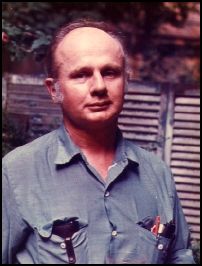
Tony Buzan is this guy. He is most famous, it seems, for his invention/discovery/renaming of the "mind map".
Here is an example of a mind map, which I found here:

Click on that picture to get a bigger version, in which the words are easier to read. I know, they're in German. But nevertheless, you get the picture I'm sure. The idea is to organise all your thoughts in a way that is memorable. Buzan is very big on memory, on training the memory, on proving to people that they have much better memories than they realised.
I live a simple life. Whenever it gets complicated, my reaction is to try to simplify it again. And then to carry on doing one simple thing at a time. This is why I took to blogging with such enthusiasm. It fits with the way I like to function. But even blogging can get complicated. With me, the complication takes the form of a whole series of complicated blog postings which I want to write accumulating in my mind, but which don't get done because none of them is capable of getting finished in time to be a today's posting. This posting is actually an example of this. And I made a conscious decision a few minutes ago to just write the damn thing, quick and dirty as the American engineers like to say, rather than do it as a great set-piece performance that I would be able to link back to for years, confident that it said everything about … it.
So maybe I should be using a Buzan mind map to get to grips with all of that, and with all the other unavoidable complexities of my life. Trouble is, the very process of making a mind map now seems to me to be too complicated. Easier to just rough out a rough and ready TO DO list, and then knock over three or four of the items on the list and go to bed happy, in the knowledge that I at least got some stuff done today.
On the other hand, I have friends who have actually used mind maps, and who are very enthusiastic about them. I'm sure these friends are right, and that I am fending off what could be a very useful tool for thinking and for living. My life actually is about to get more complicated, which I'll tell you all about in a big set piece posting Real Soon Now, and then I may have to start mind mapping myself or sink under the complications of it all.
I first heard about Tony Buzan when they had a show on BBC2 TV a few weeks back, in which he was given a group of bright by very troublesome kids to teach for a while. His aim was to turn them into "geniuses", which he failed to do. But he did get them behaving a whole hell of a lot better and smarter than they had been, and the man sure impressed me. He also impressed the professional official educators who were commentating on all this. He didn't do as well as he had hoped, but he did a lot better than most of them reckoned he would, and some of them seemed decidedly embarrassed.
Not that there's anything very mysterious about what happened. A really smart guy taught about six kids for a longish time, and taught them a lot. Which is exactly what you would expect. Simply, most teachers are (a) not as smart as Tony Buzan, but much more importantly (b) living lives that are about a thousand times more complicated than just teaching six kids day after day.
I seem to recall one of them, for example, performing the amazing trick of remembering all one hundred and six (or however many it was – I forget) cars in the car park outside. Memory again, you see.
But many teachers wouldn't have done as well as Buzan no matter how clever they were and no matter how simple the circumstances. This is because Buzan's basic method is to persuade and to inform rather than to command.
As all regulars here will know, I believe persuasion and information to be the wave of the future in education. There may still be some life yet in the old command and control methods, but in the longer run, I believe these methods to be doomed, and that the teaching profession needs to get out of that business. But, easier said than done, I realise that.

This is a real blog posting, so no link to someone else's piece in a newspaper.
Philip Chaston, who writes for Airstrip One, is in my kitchen, attending what remains of my last Friday meeting this month, and is moaning about the standard of young criminals these days.
Philip is no heavyweight boxing champion, but he tells me that from time to time, juvenile would-be muggers try to mug him outside Epsom railway station, which is apparently quite a rough place. Philip just shouts at them and they retreat in disarray.
The moral of this, says Philip, is that our education system is such garbage that even criminals aren't properly prepared for their chosen careers.
Patrick Crozier asked: "Why don't they get properly kitted up? If I was robbing people, I'd have the necessary equipment with me."
"These kids are seriously stupid", says Philip. "They can't even rob me efficiently."
More doom and gloom, to echo what those Cambridge professors (see previous posting) were saying:
The education system is "in danger of implosion" because of falling standards, North-East business leaders have warned.And proposals to revamp schooling between the ages of 14 and 19 will do nothing to address the North's serious skills shortage, according to the CBI.
It discussed a plan to replace GCSEs and A-levels with a four-tier assessment at a regional council meeting this week.
The proposals, unveiled in February by a working group headed by former chief inspector of schools Mike Tomlinson, were designed to ensure everyone leaves school with basic skills.
But CBI North-East director Steve Rankin said: "Falling standards will not be addressed. There's a real need to concentrate on three things: basic numeracy, basic literacy and attitude."
This educrat reply does not inspire confidence.
A spokeswoman for Newcastle City Council said: "Pupils deserve to be congratulated on their success, which we are sure they will take with them into working life. Newcastle Local Education Authority already has a number of successful strategies in place to improve levels of literacy and numeracy."
"Successful strategies are in place." Not: "You are wrong, our kids can read and count." So, the problem is as it is said to be by the complainer, in this case the CBI man. And a "strategy" being "in place" means that so far no improvement in the situation has actually occurred. Right?
Plus, note that the spokeswoman doesn't even say that there is a "strategy in place" to deal with "attitude", so God knows what is happening to that.
Incidentally, Patrick Crozier has been looking over my shoulder and has been saying: "I can't believe it throws out numeracy". What did be mean? It turned out he meant my spellchecker. It puts a squiggly red line under "numeracy". Great. My spellchecker is illiterate about numeracy.
This is interesting. I don't know how true it really is, but it sounds bad, doesn't it?
Secondary education in England is collapsing under the twin strains of Government pressure on schools and deteriorating pupil behaviour, a report by Cambridge University's faculty of education said yesterday.
Painting a grim picture of bored, aggressive children, hostile parents, and teachers at the end of their tether, the study said the Government's interventionist policies had brought schools to the point where they could no longer deliver what was expected of them.John MacBeath and Maurice Galton, both professors of education at Cambridge, blamed a rigid, overloaded curriculum, prescribed teaching methods, large classes, imposed targets and "high stakes testing" for creating an atmosphere of "tension and stress".
It was all aggravated by the Government's obsession with the country's performance in international league tables, which meant the pressure on children started from the age of five.
The straw that broke the camel's back was the Government's policy of "inclusion", which forced mainstream schools to admit pupils who were disturbed or had learning difficulties and would previously have gone to special schools.
I'm glad that inclusion got included in the list, and that it was granted the honoured rank of "last straw that broke the came's back".
Busy doing other stuff today, so a steal from John Holt, from chapter 16 of his book Teach Your Own:
 While teaching fifth grade, I thought often about educational leadership. For a long time, I had no idea what it was. Slowly I began to see that the atmosphere and spirit of my classes were largely determined by the students themselves, above all by two or three who, whatever might be their schoolwork or behaviour, were in fact the real leaders. Of the five fifth grade classes I taught, all of which I liked, the last was much the best – the most interesting and active, the most fun for me, the most valuable for the children. But by all usual standards it should have been one of the worst; only three of the children were really good students, and more than half the class had serious academic and/or emotional problems. What made that class the best was the two children who (without knowing or trying) led it.
One, a black boy, was by far the most brilliant student I have ever taught, and not just school-smart but life-smart, smart in everything. The other, a girl, just as much a leader, was a very poor student, but exceptionally imaginative and artistic, and also smart in the real world. What made these children such a joy to be with, and such a powerful influence on the other children, was not just their obvious alertness, imagination, curiosity, good humour, high spirits, and interest in many things, but their energy, vitality, self-respect, courage and above all, their true independence. They did not need to be bossed, told what to do. Nor were they interested in playing with me, or against me, the old school game of "You Can't Make Me Do It." No doubt they were helped by the fact that I, unlike so many adults, obviously enjoyed and valued those qualities in them that they most valued in themselves. But I did not create these qualities, they brought them to the class. What without these children might have been a miserable year turned out to be the most interesting and exciting year I ever spent in a schoolroom.
Read Natalie Solent on school league tables:
What absolutely terrifies state schools is not that the tables will fail to measure school performance accurately but that they will succeed.I rather think that the line of argument in the initial complaints, back in the days of raw results, was selected in the confident expectation that, for reasons of politics or technical difficulty, no one would ever work out a metric for value added. That made it safe to complain that the tests were unfair while not looking as if you were objecting to being assessed per se. Teachers rightly sensed that your average salesman or bank employee isn't going to weep over teachers having to undergo performance assessment when it is routine in his or her own job. Anyway, now it turns out that it was not a safe line of argument. Someone has bothered to work out a means of measuring value added. Oh sheesh kebabs.
Next question: how do you measure the "added value" of an education blog?
This is the worst case of bullying I can recall reading about since starting this blog:
Students making up an entire class in Germany have been accused of filming their torture of a new pupil and posting clips on the internet.The 11 pupils, aged between 16 and 18, went on trial yesterday, facing between them a 31-page list of charges that include beating, kicking and sexually humiliating their victim, identified only as Dieter, 18.
The attacks started weeks after Dieter joined the Werner-von-Siemens school in Hildesheim, near Hanover. His classmates took him to a store-room, where they stripped and severely beat him. They went on beating him at least twice a week over two months.
Different students participated in torture sessions, which became more frequent and cruel. By the end Dieter was being stabbed with screwdrivers, forced to eat chalk and to chew cigarette butts as well as occasionally having a bucket placed over his head while his attackers took turns pummelling him with their fists.
The students are charged with a total of 26 attacks. They allegedly filmed the abuse with a digital camera.
Nothing to add.
Incoming email from Barry Wood, full of interesting (although hard to classify) stuff and much appreciated:
Hello Brian,
I'm a regular reader of your blogs, both of which I find very informative and enjoyable. I thought you might be interested in something I came across in a local newspaper (the Surrey Comet).
Richmond Council has apparently launched a programme called "Competitive Edge" which aims to reintroduce competitive sport "to teach the children that losing is part of life".
Isn't it amazing that the day has come when the re-introduction of competitive sports to schools is news enough to merit headlines?
The wider aim – it says here – is to "help drive down truancies, teenage pregnancies and law-breaking." A pretty big claim but a welcome straw in the wind, all the same.
A friend of mine told me that all her school's canoeing and hill-walking classes had been greatly curtailed. Pressure from insurers, I believe.
I mention all this because awareness of 'resilience' as a crucial part of character seems to be growing. Thanks to authors like Martin Seligman in the US it has moved from the area of "fad" to a statement of the bleedin'-obvious backed up by hard science.
Here, resilience does not receive the emphasis it should, I believe. Instead children are bombarded with so many instructions to "live their dream" that an important part of the equation is left out.
That is the ability to cope with setbacks, to cope with failures and to overcome them.
all the best
Barry Wood
I met up for coffee, salad and chat on Sunday with my friend Elena. Elena has a quite good law degree, and has been job hunting, which was becoming pretty dispiriting on account of her fearing to be imprisoned in an office. But now it looks as if she has found a job with a real future. It seems that she may be about to become a waitress.
 Let me explain. She has already started doing the training to become a waitress for Carluccio's, a chain of shops and "caffés" (I'm guessing that this is Italian for "café"), started in Covent Garden, London, by Antonio and Priscilla Carluccio in 1991.
Elena has only been doing the training for a few days, but was already full of praise for the whole experience. Did you know that there are fourteen separate processes involved in serving someone in a Carluccio's Caffé? Apparently so. She told me what many of these processes were, but I realise that I have forgotten. But I can tell you that - if my scribbled notes of our conversation are to be depended upon - Carluccio's has 7 business objectives and 2 philosophies. Also, trainees can read The Book, whatever exactly that is.
If you click on People at the Carluccio's site, you find this:
Carluccio's is a fast-growing, exciting restaurant and food business. We are serious about real Italian food and serious about training. The most important thing for us however, is finding the right people. We are looking for enthusiastic, hard working people with a passion for Italian food who thrive on working in a busy environment.
I get the very strong feeling that in Elena they have found just such a person. It wasn't so much the details of what she said as the obvious warmth of her response to the people she had met and the trouble they were taking to prepare her for her responsibilities.
You might say: but waitressing is a dead end job. Not, I believe, waitressing for Carluccio's, if you are as enthusiastic about waitressing for Carluccio's as Elena is. Nor are all those "rational" jobs, jobs "with a good future", actually such rational jobs with such a future if you hate doing them, clock watch until you leave the building each day, and them want to forget all about them.
 I urged Elena to take the job, for the simple reason that she seemed to eager to take it. She has always been interested in the nuances of food – what's healthy what's not etc. She cares a lot about aesthetics, and she approves strongly of the aesthetics of the Carluccio's places she has seen. Carluccio's sounds like an impressive operation, that she would learn a lot by working for, with all manner of avenues for advancement. (That law degree might yet come in handy.) The Carluccio's training schemes are very highly regarded, and have won many awards, so Elena said. Simply to have done such training will itself be to have acquired knowledge well worth having, applicable in many other endeavours - knowledge of Italian food, and, perhaps even more significantly, knowledge about how to train people.
We believe in developing people to the very best of their ability. Our approach is to coach everyone to acquire an exceptional knowledge of Italy and Italian food.Our staff training is thorough and challenging, sometimes tough, but a lot of fun! Antonio and Priscilla enjoy being involved in many aspects of training and imparting their knowledge of Italy and Italian food.
The future of the developed economies is partly computers and automation and clever stuff like that. Yes. But it is also in things like Carluccio's, where the organisation and discipline and preparation traditionally only associated with things like motor car manufacturing is brought to bear on the (actually rather complicated – if you think about it as thoroughly as the Carluccios have thought about it) process of making people feel happy and welcomed and content when they visit a caffé. As well as all those computers, the future consists of people like Antonio and Priscilla Carluccio, and in due course people like Elena, telling the computer geniuses exactly what to do with their computers.
Alright, Carluccio's wouldn't suit me, and probably not you either. But that is not my point. My point is that it sounds as if it will suit my friend Elena very well.
In general, I am impressed by the speed with which a good training scheme tells everyone involved, employer and employees, whether they are going to get along and do for each other what each wants. (Nothing is more grating and dispiriting than a "company philosophy" which you do not personally care for, or which you regard as all very well in theory but not actually being followed.) Elena has, as I say, only been doing her training for a few days, yet already she seems to have absorbed an enormous amount of information. More fundamentally, she has quickly learned that Carluccio's is a world in which she is likely to feel at home, among people whose approach to life and whose "philosophy" is in tune with hers.
Working for Carluccio's will also leave time for Elena to pursue other interests, such as writing (perhaps as a freelance for magazines, and perhaps even as some kind of blogger). It will not, in short, feel like being in a prison.
By the way, in case anyone wonders why I am making such a fuss on an "education" blog of a mere "training" scheme, well, the following is my answer, which rather to my surprise I heard myself saying to Elena last Sunday: "All good education includes training - all good training includes education."
What I have in mind with this bon (in my opinion) mot is that even the most humdrum training scheme has a philosophical dimension, a meaning dimension, a dimension which addresses the question "Why?" as well as the question "How?" And all good education involves understanding something of how things get done, as well as their abstract nature and philosophical justification and a pile of written down facts about them.
To put it another way, if you like Italian food and the idea of serving it well for a living, then Antonio and Priscilla Carluccio sound like a couple of very good philosophers to get an education from.
Buona fortuna Elena. Is that how they say it over there?
Yes, more pretty pictures. Pretty pictures get people interested, and curious to find out what the text says. Plus, pictures are fun. (That, at any rate, is the thinking behind all the pretty pictures you see in children's books.)
First, a replay of an advert that has already been featured here, which I now see everywhere, this time on a bus:

Yeah mate. Get yourself a degree from London South Bank University and you won't have to spend the rest of your life riding about on a bike!
And the other two were both taken from the telly over the weekend, while I was watching the test match.
"learndirect", however exactly you spell that (the capital letters or not thing I mean – personally I would greatly prefer Learn Direct), is actually not such a bad operation if my recent experience is anything to go by, even though I presume it is run by the Government. I rang them last week in connection with finding out about digital photography courses, and they were helpful.
This, for me, is the most interesting one:

These people seem to be actually sponsoring the cricket, and this advert suggests thoughts about all manner of things that may or may not be happening in the world. But for here and now, I'll just stick with the pictures.
Yes. they are indeed sponsoring the cricket, or at any rate the broadcasting of it. Here is their logo again, this time with the Lords "Media Centre" (alias: Space Pod) in the picture.

Not that I have any idea how good Computeach actually are at teaching … Compu.
Are British children made to start formal schooling too early? Lots of people think so:
What is the right age to start formal schooling - is it four, five or six?Have we got it right in Britain, where our children start full-time schooling much younger than in most of continental Europe?
This week a school inspectors' report revived this fundamental question: one which cuts to the heart of the conflicting pressures of parental anxiety, obsession with league tables, and fears over the narrowing of the curriculum.
The report by the English inspectorate, Ofsted - Transition from the Reception Year to Year 1 - did not pull its punches.
It said parents had told inspectors they felt their children were forced to start reading and writing "too early".
Interesting argument I think. The suspicion is that "education experts" will use any excuse to chip away at national governmental tests ("obsession with league tables"), not because these are bad, but because they make teachers work better and harder, and deprive them of excuses for failing to teach effectively. Nevertheless, I believe there is a real point here.
The underlying fact here, it seems to me, is that children are, among other things, (human) animals, with a particular sort of (human) animal nature. And if an animal is not yet ready to attend to something, no amount of forcing it to pay such attention will do much good.