
From Chinaview.com:
BEIJING, May 22 (Xinhuanet) – Over 700,000 Chinese have furthered their studies in foreign countries since China implemented its reform and opening up policy in 1978, and the number keeps increasing, according to Cao Guoxing, an official of the Ministry of Education.Cao said 170,000 students have found jobs in China after they finished their studies, 350,000 are still studying or doing research abroad and the rest chose to work in foreign countries.
The Ministry of Education has worked hard to bring back the overseas Chinese students. By the end of 2003, 77 percent of the presidents and 80 percent of academicians in the Chinese Academy of Sciences and the Chinese Academy of Engineering have an overseas education background, Cao said.
I have no clear idea of what the consequences of all this will be, but it is a safe bet that there will be consequences, for China and for the rest of us.
Here's how the story ends:
Statistics of the Beijing municipal bureau of personnel show that around 50,000 students chose to work in Beijing after finishing their studies abroad, who have created over 3,800 enterprises of new and high technology.
And that, I surmise, is only the beginning of the story.

Here is an interesting piece about teachers fleeing the bureaucracy and indiscipline of English schools and working abroad.
Key quote:
"The vast majority of schools abroad hire teachers to teach," says Albert Hundspeth, who's been head teacher at British schools in Prague and Cyprus. "You are relieved of a lot of the administration that is normal in the UK system, and plenty of British schools abroad don't do the SATs tests." On the discipline front, because the schools are fee-paying there's a higher chance that the students will be well-motivated."
Imagine it. Teachers being hired to teach.
This is very strange:
English teachers are demanding an apology over the "worst ever" Shakespeare question in a test sat by 630,000 pupils last week.The 14-year-olds taking the compulsory exam on the Bard were asked in the paper on Macbeth to write as if they were agony aunts for a teenage magazine.
The question, in the paper devised by the Qualifications and Curriculum Authority, told the pupils: "In Macbeth, Banquo warns Macbeth about the witches' influence. You give advice in a magazine for young people.
"You receive this request: 'Please advise me. I have recently moved school and made some new friends. I like spending time with them but my form tutor thinks my work is suffering. What should I do? Sam.'
"Write your advice to be published in the magazine."
Bethan Marshall, a lecturer in English at King's College, London, said it was "the silliest question I have ever seen. It is a pointless, contrived link with the play which could be answered without any reference to it," she said.
Trevor Millum, of the National Association for the Teaching of English, asked: "What has this got to do with Shakespeare?"
I distinctly remember an exam at Essex University which was supposed to be about computer programming, which was actually a mere intelligence test. I'd done no computer programming work all year, but passed with flying colours.
Macbeth contains one of my favourite quotes of all, which I can imagine a lot of teachers liking, because it sums up their entire lives, or what they hope is their entire lives:
Thou shalt get kings though thou be none.
This is said by the Third Witch, to Banquo. The First Witch: "Lesser than Macbeth, and greater" – just before the quote above – is almost as good.
When the usual suspects orate about how the internet is going to "revolutionise" education, I am interested, but it usually turns out to be an exaggeration. Some promising and/or worthwhile stuff is being suggested or offer, but the world is not going to be transformed. But when the US Navy says things like this, I find myself being more impressed.
I think that the reason for the contrast between these two reactions is that the US Navy, unlike civilian educational organisations, makes a point of dishing out orders to people, and of being obeyed. Not orders to everyone, of course, but to a lot of people. "Now hear this!", as they say over their ship's loudspeakers. (They do in the movies anyway.)
 So, when US Naval officers announce that naval medical education is going to be revolutionised by being made available on line, there is an air of "whether you like it or not" about this pronouncement that is absent when civilians talk about revolutionising things.
This last stricture does not apply to actual revolutionaries. They cannot yet give orders but they mostly intend to. Civilian educators, on the whole, disbelieve in giving orders. They believe in things like arousing enthusiasm, and in attracting attention with pretty little pictures. They believe in "engagement". They believe in the voluntary principle.
The US navy believes in pretty little pictures also, as the particular pretty little picture that I have used to decorate this posting illustrates. But read what it says. It says: "Naval Medical Education and Training Command." Command. Civilian educators don't like to use words like "command" these days.
Personally, I think that the civilian educators are a lot more right than wrong. But I further believe that following the logic of not using the word "command" will have revolutionary consequences, and that a lot of these same civilian educators are liable to end up as revolutionees.
Joanne Jacobs, who is indifferent to pictorial content on account of having sufficient content of her own, links to this picture, which unlike her I here reproduce:
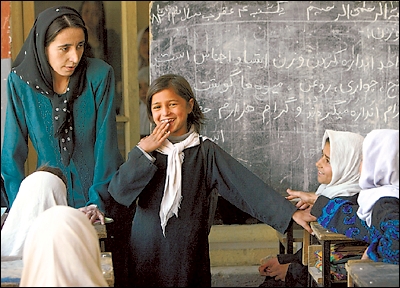
Here's how the accompanying Christian Science Monitor story starts:
A second-grade math class in Kabul, Afghanistan, met in the school breezeway with a blackboard on wheels. The young scholar was shy about speaking in front of her class. A proud teacher watched. A classmate reached out her hand to offer support.This scene, so natural, so universal, was nonexistent in Afghanistan for many years when the Taliban were in power. Laws prohibited women and girls from attending school or even leaving their homes.
A breezeway sounds like something out of doors.
Instapundit linked to Assymetric Information about this, and that's how I found this, about the contribution made by women in recent decades to increased GDP. This contribution, says Jane Galt, has been made possible by the massively reduced time now needed to run a home, cook meals, clean up, do laundry:
My mother stayed home with us. By the time I was ten, she was going bonkers. There simply wasn't enough to do in the house . . . and my mother, mind you, had gone in for gourmet cooking in a rather large way, producing elaborate dinners that took hours to prepare. She was the mainstay of the PTA, the building's co-op board, and so forth. Nonetheless, there simply wasn't enough to keep an active woman occupied after the children were in school.Women in the house, other than those with small children, became economically useless to their families once labour-saving devices and modern food processing made 90% of their labour obsolete. So they went to work.
Thus, I'd argue that the GDP growth we experienced when women went to work is measuring the same thing as other kinds of GDP growth: the movement of labour resources from less valued to more valued uses.
However:
This has created a problem, of course: women's work used to be compatible with child care, and now it is not. And the business world is still largely designed for men: it is not structured to accommodate professional women who stay home with young children. On that, more later.
And this posting should remind me to got back for the"more later" that she promises.
Commenter lindenen echoes that last point:
All those kids who decide to shoot up their classmates, would they have sunk to this level if someone had been parenting the kids? I think there are a lot of indirect negative effects that we are only just beginning to deal with.
Agreed.
If you think about it, raising children is all about – and I know it's uncool to quote yourself but uncoolness be damned - this (see my immediately previous posting):
In the longer term, I believe that the "answer" to children abusing drugs is to rearrange the immediate incentive structure that the average school-child now faces. If more children made a more immediate contribution to the world, and got immediate rewards for doing so, and more immediate punishments for not making such a contribution, then drug abuse, which would not be rewarded and would be punished, might diminish, although it would never completely go away.
When Old Fashioned Mum did her housework, her kids either helped (even if it was only by not being a nuisance) and were praised, or were a nuisance and got scolded. They got attention, nice or nasty according to whether they were contributing or not contributing. But when New Mum goes to work, all that stuff gets switched off. New Mum therefore, in a very basic sense, separates children from the realities of the world, personified by … herself.
And people who live in an unreal world, stripped of all economic rationality, do drugs. Drugs make unreality a whole hell of a lot more exciting, and don't result in any income being foregone. There may later be disapproval, but it is not immediate. The drugged gratification is immediate. lindenen is right. Kids whom Mum neglects are liable to shoot up.
And far too many schools are like neglectful Mums. At least those sniffer dogs (again: see previous posting) mean that someone is paying attention.
David Carr writes at Samizdata about the use of sniffer dogs in schools, and wonders why there is so much less fuss about that than about prisoner abuse in Iraq, i.e. he disapproves.
Me, I think that if you favour compulsory schooling, you have to accept that (a) schools are then prisons, and that (b) since you get drug abuse in prisons, you are also liable to get it in schools, and that meanwhile (c) a school where drug abuse is controlled is probably better than one where it isn't.
In the longer term, I believe that the "answer" to children abusing drugs is to rearrange the immediate incentive structure that the average school-child now faces. If more children made a more immediate contribution to the world, and got immediate rewards for doing so, and hence more immediate punishments for not making such a contribution, then drug abuse, which would not be rewarded and would be punished, might diminish, although it would never completely go away.
Note that I do believe that there is such a thing as "drug abuse". I do believe that marijuana, to take a favourite example of the pro-drugs enthusiasts, is potentially a quite harmful drug. I do not regard this as inconsistent with favouring the legalisation of all drugs. Drugs are dangerous, but only directly dangerous to those who take them. The harm that drug abusers do to themselves shouldn't be a criminal matter, any more than the harm done by alcohol abusers should, in itself, be a crime. The crimes that abusers commit as a result of their abuse should, on the other hand, be treated as the crimes that they are.
And while we're talking about crime, I think that the age of criminal responsibility, as of economic and political emancipation, should now be lowered, to the beginning of teenagerdom. Votes at thirteen. Criminalisation for crimes at thirteen, no compulsory schooling from thirteen onwards, etc..
Children are powerful, as soon as they want to be (i.e. as soon as they become "teenagers"), and no good comes from attempting to sustain a political regime based on unreality, or on such irrelevancies as the fact that many children of that age are stupid. So are many adults, but that doesn't mean that stupid adults get locked up in schools indefinitely and searched by sniffer dogs for the drugs that they would then also drugs in huge quantities.
There is another posting here about how the market educates, plus yet another about how modern technology empowers children. Expect these Real Soon Now.
More from the count your blessings department:
Fari Dube, the deputy headteacher of Bulawayo's Nkwalongwalo primary school, said that before the WFP donated maize to make porridge, children used to faint in their classrooms. "In truth, some of the staff are also starving."
That was just a throwaway bit at the end of the piece.
The WFP is Robert Mugabe's lot, the maize they so graciously donated having first been stolen.
It shows, though, how serious people are about education in those parts.
Another email from my friend the Kent schoolteacher:
In my previous posting on Brian's blog I was planning to leave the School from Hell I was teaching at and start somewhere new in September. I left much sooner.
I arrived one morning at my department to find a boy out of lessons, when challenged I was met with the usual torrent of abuse. The Head of Department (HoD) came out (somewhat surprisingly) to see what the commotion was about and told me he was a known troublemaker and that I should go to my room and lock the door. "Lock the door?" I asked. "Yes" was the reply, "to be on the safe side."
I hid in my locked room and waited. The boy began banging on my door and issuing a variety of threats. I tried to ignore him, so he went outside and began banging on my window. At this point I summoned help on the phone that fortunately (only) I had in an adjacent store room. Someone actually
came and took him away. Good. The next proper lesson I had resulted in another assault on me (being pushed around etc.) I phoned for help again and had someone taken away. Double good. So far, so good. Just another 'normal' day at this school.
The next day I find a note in my pigeon-hole from a member of the Senior Management Team (SMT). My facility to have pupils removed for misbehaviour was being withdrawn as I was using it too much. My HoD knew nothing of the decision, nor did the support staff who actually did the removing. The
Head had already said that pupils could not be sent out of rooms (as they merely went and disrupted other lessons) so I just had to cope with them – without any support.
That was it. I was furious. I asked the support staff what they thought of it and they couldn't understand it. Other teachers thought it ridiculous. I went to see one of my colleagues who'd had similar problems. I found him at the back of his room, head in hands shaking. He'd just had another day of teaching at this school. "That's going to be me anytime soon" I thought to myself.
I made up my mind. Next morning I phoned in sick. And the next. I went to see my GP who, after explaining the situation wrote me a three week sick note for 'stress'. I wrote a letter to my Head explaining that I would not be returning.
I now had to find a supply job for the Summer Term ...