
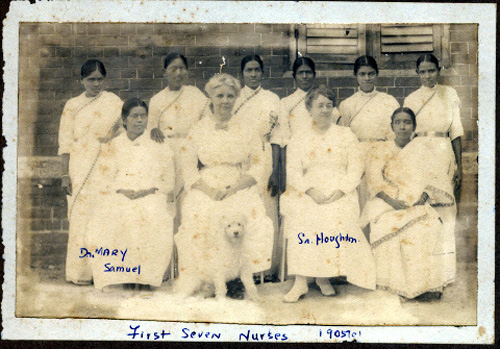
I googled, as is my wont, "education", and this time, as has become my frequent wont, I tried "images", and stumbled into some Indian medical/educational history. I found my way to the archives page of the Christian Medical College Vellore (in Southern India), which was founded about a century ago by Miss Ida Sophia Scudder MD, who I'm guessing was an American missionary. It's the kind of place that isn't talked about much now, but the pictures at this page evoke a vanished world of White Man's burden, or in this case White Woman's Burden.
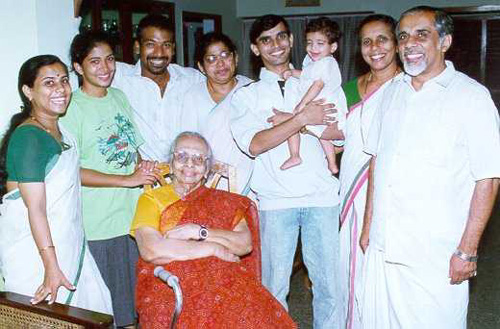
The place still seems to be going strong, as this page of more recent photos, in colour, illustrates.
I enjoy this kind of thing, and I really enjoy the way you can chat about such things on the internet.

More worrying reported here that kids these days don't know how to communicate like they used to, this time the kids being the very young ones.
A recent survey of nursery staff carried out by I Can, a children's charity, revealed that almost all had at least one child in the nursery with communication problems. Ten per cent said they had 10 or more children with difficulties.They reported that growing numbers of pre-school children could not accomplish simple tasks such as explaining what they were doing, concentrating, speaking clearly and following instructions. They said that children often responded with monosyllabic answers or gestures, rather than appropriate language.
Staff pinpointed several factors for the increase: 92 per cent felt that the lack of adult time spent talking with the children was the key reason and 82 per cent blamed the passive use of television. Two thirds mentioned a trend for parents to talk for their child and others suggested that the use of videos and computers was also to blame. Almost half felt the situation was a matter of extreme concern.
"The hard research evidence isn't there as yet because it hasn't been done," says Gill Edelman, chief executive of I Can."But there is a growing body of opinion among professionals that there are more children than there used to be with communication difficulties - and boys are three times more likely to have problems than girls. Early intervention is critical because by the time they get to primary school they may already have developed behavioural problems through frustration.
My fantasy solution is to get all those useless teenagers who now lounge around taking drugs and being disaffected to make themselves useful, by talking to the little tots. Dealing with the reality of such creatures might dissuade them from creating more themselves, before they are ready to look after them properly (see above), and it would help.
On those days when I have been living life as life is generally understood (i.e. working and going out), I sometimes find myself at the end of the day and in need of a quick posting. And it is at times like those (i.e. these) that I am rather more welcoming of emails like this one than I usually am.
Dear Brian,
I would like to invite you to visit our site at http://www.readingsuccesslab.com and introduce you to the Cognitive Aptitude Assessment Software, developed by internationally recognized Psychology Professor Mike Royer, Ph. D. of the Laboratory for the Assessment and Training of Academic Skills, University of Massachusetts Amherst and software developer Jeremy Wise, Ph.D.
With 15 years of research behind them, the Drs. have recently introduced a free reading assessment test designed for home use and ideal for families, homeschool families, those with special learning needs and educators. The Reading Success Lab™ FREE Reading Assessment Test is a unique screening test to identify readers with disabilities. Other free tests typically ask a series of paper and pencil questions regarding a reader's struggles with reading.
Our test actually tests reading skills. The software measures both the accuracy of response (did the reader make the correct answer), and the timeliness of the response (how quickly did the reader make the correct answer). Measuring timeliness indicates whether the reader has mastered the skill or struggles with the skill.
We believe the application of the software for families has proved to meet many of their concerns about learning problems. The soon to be released full assessment software will provide a full diagnosis with recommendations for intervention, all with ease from home. Test the whole family with software customizable to multiple age levels.
If you try the software, like it and consider it a good resource for your visitors, we would appreciate a link from your site. We believe CAAS, is an important resource for all families.
Dr. Royer and Dr. Wise are very eager for feedback and also for an honest discussion about the software, it’s use and application. Please let us know if you have any questions or comments of any kind.
With kind regards,
Debra PaynterCustomerCare@readingsuccesslab.com
Other of our sites we welcome you to check out
http://www.educationalhelp.com/companyprofile.html
http://www.jeremywisephd.com/ for Jeremy Wise, Ph.D.
http://www.jamesmroyerphd.com/ for Mike Royer, Ph. D.
http://www.umass.edu/latas/ to visit the Laboratory for the Assessment and Training of Academic Skills
http://www.cognitive-aptitude-assessment-software.com/ for the Researcher Version
Make of this whatever you will.
In the latest issue of Prospect, Philip Collins writes about the public sector generally, and Ofsted inspections in particular:
The better regulation task force recently asked government to tell it how many regulators now existed because it was struggling to count them. No doubt there could be fewer of them. And, of course, the inspectorate has never been exactly popular with professionals. David Bell, the chief inspector of schools, has recently responded to criticism by saying that Ofsted needs to become more rigorous in its methods, to drop in at shorter notice and leave well-performing schools alone. Inspection in the future will be less burdensome, less intent on naming and shaming and more directly concentrated on dispersing good ideas. This change of focus is possible partly because Ofsted's initial work, attacking entrenched failure, has been a success. Its alarming report on reading standards in London was the catalyst for the national literacy strategy in 1998. Ninety per cent of schools now show satisfactory improvement between their first and second inspection. The proportion of 16 year olds who obtained no GCSEs above grade D has fallen every year since 1994, when inspections were introduced. For all the anguish that Ofsted inspections create, most teachers would prefer to reform the system rather than abolish it. And the information provided is indispensable for parents. Britain probably now has the most transparent schools system in the world. As David Bell said recently: "It is easy to forget what the education system was like without the publication of examination and test results."
Well, that's one way of looking at the public sector. I am of course a public sector pessimist, but Collins writes throughout his piece as if the right (instead of wrong) new procedures, the right (instead of wrong) new reforms, the right (instead of wrong) new initiatives, will finally make it all work well. At one point, for example, he even lists some massive spending increases as prima facie evidence of improvement, when for those of us who oppose the whole idea of a large and active public sector the ever increasing cost of the thing as all part of what a catastrophe it is.
Collins is a sort of friend, in the sense that he is a very good friend of a very good friend, and I therefore wish I could say that I liked his article more than I did.
I take friends, and therefore friends of friends, seriously, not just for their own sake, but as sources of information. I pick up some of my best postings at social gatherings, when trusted individual friends report to me on individual experiences which I can pretty much guarantee are true, and one of the more vivid such recollections I gathered recently was from my friend John Washington. He works at what it is most definitely a good school, by practically any way you care to measure these things. Certainly the parents involved think it's good, or they wouldn't be paying the quite large fees. Yet Ofsted insists on an elaborate inspection of this place every few years.
When I last spoke to John, they had just been having such an inspection. He and all his colleagues had been filling in lots of forms about their pre-prepared written "lesson plans", even though this not a procedure which John actually follows; he just turns up and teaches.
A few things I recall in particular from what John said. One, his guestimate of what all this was costing was "around £40,000 I suppose". Two, the school had to pay this. Three, the amount of paperwork involved filled, if I recall John's hand gestures accurately, about half a room.
Who the hell is going to read this report? And what possible purpose does it serve? It seems to me that inspections like this embody the same error that Philip Collins himself makes in his Prospect article, namely the belief that if enough things are done, and (in this case) if enough "information" is gathered, eventually the gatherers will chance upon the perfect system (in this case of state education). Actually, the endless and ever more expensive search by bureaucrats for systemic perfection is one of the major problems of the system, and will go on being for as long as the search persists.
I caught a snatch of a London TV news report this evening about how German universities are trying to persuade British students to do their degrees in Germany, for free. No need to worry about loans and top-ups if you go there.
What they didn't explain was what was in it for Germany. Is it that they can't stand their own students and figure that they'll get slightly better ones this way? Are they trying to make sure they learn and teach English idiomatically, complete with up-to-date swearing?
Touting for business I could understand, but where is the business here?
Google google – this is the same story. Yes, the mentioned a woman called Lemmens on the TV.
Quote:
LONDON - Free higher education in the home of Western civilization's most provocative thinkers, a chance to learn a second language - and a legal drinking age of 16? It's a formula that might appeal to both stressed parents and students alike!Germany is willing to accommodate what could be a dream for many American families, worried about the skyrocketing cost of higher education.
“Our idea is to get the best people to the universities,” said Nina Lemmens, the London-based director of the German Academic Exchange Service, the DAAD.
This week, Lemmens has been promoting the free international degree program in English to British students, who also are worried about higher college fees. But she explained the German universities also are keen on recruiting American and other international students for their tuition-free programs.
Maybe the snag is you have to be extremely well schooled to qualify. But, does anyone have any further light to shed on this apparently rather odd little sales trip?
Is it perhaps some insane unintended consequence of German quota-fulfilment arrangements, where they are desperate for educational bums on seats because that's how they are paid, even though the bum-owners pay nothing?
There is a fascinating article by Cherryl Barron in the latest Prospect (April 2004 – paper only so far as I can work out) about the reasons for the Indian computer software miracle.
The emergence of India as a software superpower is still generally attributed to the cheapness of its programmers and software engineers. But the underlying reasons are more complex and interesting, lying in the subcontinent's intellectual and pedagogical traditions.Software is ubiquitous. It is at the core of processes in every strategic industry, from banking to defence. And the depth of India's advantage in software suggests that it poses a bigger challenge to the western economies than even China. China, strong in manufacturing and computer hardware, has been almost as unimpressive in software as Japan. Indeed, no developing country has ever taken on the developed world in a craft as sophisticated and important as software.
Indian software aptitude rests on both the emphasis on learning by rote in Indian schools, and a facility and reverence for abstract thought. These biases of Indian education are usually considered mutually exclusive in the west, where a capacity for abstraction is associated with creativity. In India, learning by rote is seen by most conventional teachers as essential grounding for speculation.
An educational tradition that spans learning by heart and exalting excellence in higher mathematics is just right for software. It fits the mentality of computers. These are, after all, machines so fastidious as to refuse to send email with a missing hyphen or full stop in an address. Yet no product on earth is as abstract, boundlessly complex and flexible as software. It cannot be seen, heard, smelled, tasted or touched and is, to borrow Nabokov's description of chess – a game invented in India – a "spectral art."
India's software accomplishments reflect those extremes. Indian firms dominate a world elite of over 120 companies recognised for producing outstandingly accurate software, those which have earned a CMM Level-6 tag, software's equivalent of the Michelin 3-star rating. These establishments – of which America has less than half the Indian total—are certified to be following an exacting, detail-ridden methodology developed at Carnegie-Mellon University in Pittsburgh for producing reliable code.
At the other pole of cyber-sophistication, most of the reigning US technology giants – Microsoft, General Electric, Texas Instruments, Intel, Oracle and Sun Microsystems – have established software design and development facilities and even R&D laboratories in India to take advantage of the world-class brains produced by the Indian institutes of technology, willing to work for an eighth of the starting salary of their US counterparts.
This next bit also alludes, perhaps without intending to, to what used to be wrong with people educated in India.
Western programmers' view of their craft tends to stress its more rarefied dimensions, such as this description by the US computer scientist Frederick Brooks: "The programmer, like the poet, works only slightly removed from pure thought-stuff. He builds his castles in the air, from air, creating by exertion of the imagination. Few media of creation are so flexible ... so readily capable of realising grand conceptual structures."Yet "pure thought-stuff" is also an encapsulation of ancient India's contributions to the world's scientific heritage. In about 600 BC, before the Greeks, some schools of physics in India developed atomic theories, based not on experiment but purely on intuition and logic. Some western physicists marvel at how much closer the imaginative speculations of Brahmin atomic theory have come to current ideas in theoretical physics than those of any other pre-modern civilisation.
"The Indians advanced astronomy by mathematics rather than by deductions elicited from nature," the science writer Dick Teresi has noted in Lost Discoveries. Indian mathematics was also distinctively airy-fairy. Whereas Greek mathematics was largely extrapolated from mensuration and geometry, the ancient Indians most distinguished themselves in abstract number theory. Zero, infinity, negative and irrational numbers – all concepts that the Greeks dismissed as ludicrous – were Indian concepts.
Airy-fairy. "Pure-thought-stuff." Yes, that sums up the cliché stereotype Indian university graduate of my (older) generation. Very big on abstraction, can talk the hind leg off a donkey, but no bloody use for anything except becoming a bureaucrat and driving the Indian economy – what little there used to be of it – ever deeper into the dust.
Spatial extension and quantities of objects were far less interesting to pioneering Indian mathematical minds. In fact, the Indian leaning towards abstraction – so deep-seated that theoretical physicists and mathematicians still outrank every other sort of egghead in status – explains India's relatively poor showing, historically, in more practical sciences. The sinologist Joseph Needham observed that more practical study would have entailed defying Indian caste rules about contact between Brahmins and artisans. Similarly, the progress of ancient Indian knowledge of physiology, biology and anatomy was held back by the taboo on contact with dead bodies.
All of this brings to mind a remark by Peter Drucker from long ago to the effect that computers have provided something never before seen in the world, namely: paying jobs for mathematicians.
Could it be that the way that computers have enticed all these airy-fairies and pure-thought-stuffers away from being government bureaucrats will turn out to be their most important beneficial contribution to the Indian economy? Yes, these people are doing splendid things with their computers, but think of all the abysmal things they used to do and might still be doing instead, were it not for computers.
I can confirm the excellence of Indians at maths with one extremely anecdotal anecdote. By far the cleverest attender (way ahead of me) of those Kumon maths sessions I occasionally mention here was an Indian boy of about eleven or twelve. (One of the "slumbering giant" glories of Kumon is that it enables Kumon instructors to accept and help to educate pupils who are cleverer than they are. I think this is the single most impressive thing about Kumon. Think about that. But I digress.)
Barron ends as she began, by contrasting India with China:
It was the supreme pragmatists, the Chinese – whose intellectual traditions favoured practicality and action over airy speculation – who were the technological geniuses of antiquity. They invented paper, seismographs, the magnetic compass, the wheelbarrow, irrigation, ink and porcelain. But reasoning for its own sake was of so little interest to them that, unlike the Greeks and Indians, they never developed any system of formal logic. It hardly seems accidental that it is through the manufacture of physical objects that China is making its mark today, while India floats on the ethereal plane of software.
As regulars here will know, I have been trying recently to liven up this blog with pictures. And I think it says something about the priorities of Indian civilisation just now that when I typed "India" and "Mathematics" into Google, the pictures were all either terrible or irrelevant. How do you illustrate an ethereal plane? Just an Indian guy in front of a blackboard covered in mathematical symbols would have done nicely, but I could find nothing like that.
Lots of stuff about Ramanujan, though.
Perhaps you recall that I've been reading about the great language teacher Michel Thomas. I have recovered the book about him which I temporarily mislaid, for which thanks to the relevant people. I've not yet encountered any bits about the man's own remarkable teaching methods, but I did encounter this fascinating bit about the man's own education. Thomas was born in Poland, but while still a child he moved to Germany.
By the age of sixteen Michel began to feel that he had outstripped the school he attended and no longer felt challenged. 'I was anxious to get it over with.' He developed a plan in which he would take extensive private instruction instead of school work, enabling him to gain a year. He took the idea to the principal, who instantly rejected it.
Undeterred, he started shopping around for alternatives, an outlandish concept for a student at that time. He chose a Gymnasium attended by children of the militaristic upper-class Junkers, a school known to be rigid in its educational methods and unforgiving in its academic standards. ('It certainly had no Jews.') But the principal, although a severe disciplinarian of the old school, was sympathetic to a teenager's passion to learn. He accepted the scheme.
At the same rime, Michel sought out a private tutor. He chose a highly educated intellectual in the city, Dr Karl Riesenfeld, a musicologist who wrote opera reviews and literary criticism in the highbrow publications. 'He was a walking encyclopaedia. I explained I wanted to leave school early and go on to university, and that I wanted him to teach me personally.' When pressed, Michel admitted that he had not yet spoken to his family about the idea. Not surprisingly, the professor turned him down. Michel refused to take no for an answer.
Riesenfeld tried to brush him off, saying he was busy: 'Besides, summer is coming and I will be travelling.'
'Fine,' Michel said. 'I'll come with you.'
He was passionate and persuasive, and the professor finally agreed to talk to Michel's family, and that if they consented something might be worked out.
 That same evening at dinner Michel decided it was a good time to speak to his aunt and uncle about the various far-reaching arrangements he had made for his life. 'I've quit school and I'm not going back.' He explained he had left his old school and was intending to go to a more demanding establishment, finish a year early and go to university. 'I gave them my reasons and told them what I had achieved, that a Junkers Gymnasium had accepted my plan, and that this brilliant man was prepared to talk to them about private instruction. I must say they were impressed by my initiative.' He was granted his wish, and was also allowed to travel with his chosen Aristotle.
They visited the Alpine resorts of Austria, the Italian Dolomites and the cities of northern Italy. Michel studied every day, and discussed history and art, hour after hour. 'I started looking at history through different eyes than those at school. The professor was a learned man, but brought people and places to life. I began to see great historical personages not as figures detached in time who fought some war, but as real people. I started to question what they were like and what motivated them. I developed critical thinking and evaluation – not accepting what I was told and read, which was very un-German at the time. It was one of the greatest learning experiences of my life.' He had previously been weak in mathematics, a subject he had no interest in and for which he was convinced he had no ability, but the professor changed all that. 'Through challenge and love I became a reasonable mathematician. He showed me that there is nothing so complicated that it cannot be made simple, and the concept of reducing complexities later became a cornerstone of my teaching.'
Today I attended the fortieth birthday party of my friend Alastair James, at his home in south London and I write in haste, to have something up here today even though it is Sunday.
I got to know Alastair via libertarianism, the Libertarian Alliance - to which, among much else, he contributed this LA publication. (Link to the LA website not now working, link to follow.) He now works for Deloittes, in the management consultancy bit, and he has recently been interviewing the Deloittes graduate intake.
He said that the quality was very high, and that they were all intensely focussed and ambitious, and that they had all been doing all manner of extra-curricular activities like white water rafting up the Zambezi etc., which would look good on their CVs, and because they would look good on their CVs. Their business acumen and general level of managerial savvy was remarkable, and far higher than that of Alastair's own generation, or of the generations before that. But ... they couldn't write.
Not couldn't write as in couldn't write as well as Charles Dickens or Edward Gibbon (I cross-examined Alastair on this exact point), but couldn't write as in couldn't communicate clearly in writing, to anyone, not even to each other. Their grasp of English grammar was tenuous to non-existent. Not having actually read anything these crown princes had written I can't quote you chapter and verse, but that was the guts of Alastair's complaint.
I asked Alastair if they could they speak clearly. A bit more clearly, but not very, was the answer. Alastair explained how he got them to say what they had been trying and utterly failing to say in writing, and he then said: go away and put that, and then come back and we'll see how you did. And they couldn't do that either. They couldn't write clearly, even when they were stressing and straining at it flat out, not as if their futures depended on it, but when their futures actually did depend on it.
These are not underclass rejects. Quite the opposite. This is the cream of the crop, the human fizz on the champagne of Western Civilisation. Graduates. Post-graduates. Super-graduates. The next generation of leaders. And they can't communicate properly.
Depressing. And in fact Alastair later told me that the state of education is indeed one of the things about the world which now most depresses him.
I get the feeling that I may end up as a teacher of English grammar. Maybe, when I've mastered the art of teaching English grammar, I'll apply to Deloittes for a job. The subject I will teach will be called "uncreative writing".