
I've been reading the English version of China's 'People's' Daily. See also: China refutes US censure on human rights, and the sneer quotes to describe Taiwan 'election', which is rich coming from them, and which is why I have sneer quoted the 'People's' bit in 'People's' Daily by way of retaliation.
Anyway, according to this story, the Chinese are working their kids hard. Mere school is only the beginning of the story.
Two tough times begin when regular school ends on Friday afternoon for Xiao Di, a grade-two pupil in a primary school in Beijing's Dongcheng District.Here is her schedule:
Sightreading and music theory on Friday evening.
Math and English on Saturday morning.
Piano on Saturday afternoon.
Dance on Sunday afternoon.
Sunday morning free? No! It is reserved for homework assigned by her teachers at her regular school.
What is all this frenetic activity in aid of? Have the children, or rather, their parents, got a problem?
Yes. Why all this frenetic activity?
"It all boils down to one word – competition,'' says Hong Chengwen, a pedagogy specialist at Beijing Normal University.All this, especially the math and English, has something to do with preparing for junior high school in the immediate future.
But junior high is not the ultimate goal, nor is senior high, though both are vitally important stepping stones in the children's long road to getting established in a successful career.
It is university entrance, though still a long way away, that is behind all this week-end fuss today.
"A high score in the college entrance examination makes all the difference between the success and failure for a student. At least, a significant portion of the students – and their parents – think so; in spite of the fact that we educators and the educational authorities repeatedly trumpet the value of pluralistic approaches to success,'' Hong says.
The college entrance examination is a one-shot deal. You make it, you win. You don't, you lose – with not much chance of a second chance, says Hong of the harsh reality the students must face.
But do art and music have anything to do with university enrolment? Yes, they do. Universities are being given more and more power over who they may take in as students, and many of these schools are eager to recruit artistically accomplished or athletically gifted students to help boost their image at music, art and sports events organized among universities. These "special-skill students,'' as they are referred to, therefore have a better chance of getting into prestigious universities, because their artistic or athletic skills can count as part of their entrance-exam scores.
"Universities are being given more and more power over who they may take in as students …" That's an interesting little titbit, isn't it?
But, earlier in the game, some "key" junior high schools also pick for enrolment the "special-skill'' pupils and those who excel in the "killer'' math and English courses, from the primary schools.
And as if all that isn't enough …
Beyond the competition factor, many dads and mums want their children to develop in an all-around way. This helps explain why so many kids are studying dance, singing, piano, painting and so on, even though it is obvious to all that only a very small number of the children have any chance of becoming professional artists or musicians.
So, ferocious competition to get into university, and they have to be "all-rounders".
My guess would be that all this is approximately true. And isn't it interesting that this is now how the rulers of China now want the world to see them?
Here's a Boston Globe article about home education.
This was my favourite bit:
Bryanna Rosenblatt says her public school friends envy her, because they all think she's home in her pajamas all day. But she keeps herself on a regular routine: up, showered and dressed by 8 a.m., tackling a curriculum of her own design. Clonlara School, a Michigan-based home-school program, offers an accredited online high school that tracks Bryanna's classes, and will provide a transcript come time to apply to college.Home-schoolers who don't correspond with online high schools are creative in how they document what they do, so that they can demonstrate to school districts - and later to colleges - what they are learning. Many are diligent in logging daily activities, with each tallied in a different column. Playing Monopoly is math. Chess is critical thinking. Collecting stamps is history. Attending concerts is fine art. Pen pals and e-mail count as writing.
Bryanna is a pretty, ponytailed girl who likes to keep her hands jammed deep in the pockets of her black sweatshirt, emblazoned with CKY, the culty band that celebrates skateboarding, skits, and stunts. Her home-schooling experience is much more structured than her mother, Tammy Rosenblatt, had ever envisioned. Since Tammy decided to home-school Bryanna in kindergarten, she's always imagined Bryanna following her intellectual abilities into unusual educational opportunities. But Bryanna craves structure. She found some textbook catalogs in her mother's car and insisted that she get some. And she sets aside a few hours a day to lead herself through school books about literature, science, and algebra.
"I felt like a failure when she wanted textbooks," says Tammy. "I didn't think we home-schoolers were supposed to use them. But I also know that we're supposed to be flexible."
This reminds me of a favourite cartoon. Scruffy parents, very small boy in very smart suit, including collar and tie. Caption: "Yes, we wanted to raise him as an anarchist, but he wouldn't be told."
That Clonlara home-school program is presumably this.
A Brian's Friday is drawing to a close, and my speaker, Antoine Clarke, who was, as always, most eloquent, is rambling to me about education while he makes himself a cup of tea.
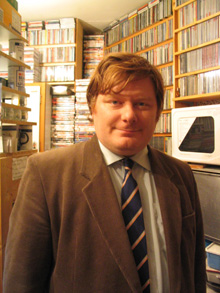 Antoine tells me that he has just been visiting the Friends Reunited website, and they have ancient tests up there which you can take. Old 11+ exams, and GCSEs, but not O or A levels.
Antoine tried all the papers they had. The 11+ paper dated from the late 1940s. The GCSE paper was about 1990. The subjects, for 11+ were: verbal reasoning, maths, and science; and for GCSE they were: maths, physics and biology.
His worst score was verbal reasoning for the 11+, and his worst score in the GCSE was 80 per cent, which was in maths. Antoine is bi-lingual in English and French and has taken numerous exams in French as well as in English, and he says he has never gained a "pass" score in a French maths exam.
Looking at the standard of the exams generally, he thought that the GCSE would have been tough for his year at school when he was ten, but that most of his mates would have passed at any time after that.
His conclusion is that the modern English GCSE exam is primary school standard for the 1970s, and doesn't compare at all with the 1940s 11+.
In short, dumbing down is no myth.
Category: Examinations and qualifications • History
 [0]
[1]
[0]
[1]
The headline makes the point on its own:
School Trains Girls to Be Good Wives
Which makes you wonder if perhaps it might make sense to have another headline about how:
School Trains Boys to Be Good Husbands
No link for that because I made it up. And I suppose the good schools already do teach this. (Get a job.)
Deep thanks to Dave Barry, where MOTW comments as follows, on a related educational theme:
When I was in college (1998), those students in the Business College were required to attend an Etiquette Dinner. It was a five course meal and several faculty attended. This was to teach students how to engage in small talk, to know which fork to use, where the napkin goes, don't talk with your mouth full, etc. It prepared them so that when the student was out at a business lunch or dinner, they would not embarrass themselves and ruin their career with a horrendous lapse of manners.You may laugh and poke fun at this, but manners really are largely lacking in society today.
And there is plenty more about education as it used to be, in the Good Old Days when people held their forks correctly instead of only using them to poke fun. Worth a look.
I love this comment, from S. Weasel, on this at Samizdata today, which speaks for itself:
You know, bob, promoting the importance of education using horribly mangled syntax has got to have a cracking good joke in it somehow. I just can't think what it is.
No, that is the joke and you just cracked it.
I've recently put two stories up at Samizdata on educational themes. The first is a straight copy and paste job, with a only a small burst of preliminary chat from me, of David Gillies' comment here on this posting, about academic cheating. I also linked from Samizdata to this highly recommendable recollection by Natalie Solent, on the same subject, also written in the first person.
And the second is a reaction to this Telegraph article about how a British mum has been jailed for failing to prevent her daughter's truancy.
Susan Elkin, writing in yesterday's Telegraph, thinks that things have been improving:
When my father, a former teacher in Deptford, south London, heard that I was starting my teaching career at a notorious secondary boys' school in the area, his laconic comment was: "Well, if you survive there, girl, you'll cope anywhere."How right he was. It was 1968. I was 21 and had come straight from an appalling "child centered" teacher training college that had managed to teach me absolutely nothing in three years about classroom realities.
I was the first woman to teach in that macho, multi-cultural environment, where boys were frequently caned, "slippered" or cuffed about the head and everyone shouted continually. Learning was the least of anyone's concerns.
The expectations of staff, parents and pupils were off the bottom of the scale. Pupil crime rates probably outstripped those in the nearest prison. You could smell the boys' stinking urinals from 100 paces. And several of the staff were definitely not the sort to whom any caring parent would entrust her children. Criminal Records Bureau checks lay more than three decades into the future.
Reflecting on all this 36 years and four schools later, as I look forward to retirement from teaching this summer, I am struck by just how much things have improved.
… and what is more, you can't help noticing, how much things have improved thanks to government oversight, command, control, training, standards, and – who knows? – perhaps even initiatives.
It does make me wonder though, whether what we might perhaps be reading about here is actually a case where the observer has influenced her own findings. Such has been Susan Elkin's effectiveness and career moves that things in her vicinity have indeed been improving, but outside of her influence, not so much so. Maybe that's the real story.
Mind you, you could say exactly the equal and opposite things about all the defeated grumps who say that things have only been getting worse and worse.
This certainly makes a change from the usual stuff you read.
A British University is going to set up shop in China:
The University of Nottingham is to open a campus in China.This £40m project, agreed with the Chinese education authorities, will be the first time a UK university has opened a purpose-built campus in China.
The first Chinese students are expected to start courses in September - with the start-up academic staff being deployed from the UK.
The university says "internationalisation" is an important part of higher education's future.
And so do I. After all, what with cheap international phone calls, and email, the internet, etc., it has suddenly become a whole lot easier to organise this kind of operation.
Any, er, problems?
Addressing human rights concerns, the university says: "We shall extend to our China campus our approach of working with Chinese institutions, presenting students with a balanced viewpoint, and teaching in different ways (with more independent thinking)."We think this will go well with reform and modernisation in China itself."
Fingers crossed, in other words.
The boss of the China operation is a revealing choice.
The vice-president of the Ningbo campus will be Professor Ian Gow, formerly director of Nottingham University Business School.
It figures. These days, the business of China is business.
The other day I was out photographing, and not long after taking this picture, I chanced upon these statues:


Here's what it says on the plinth that the girl is sitting on, somewhat photoshopped, to make it easier to read:

Royal Military Asylum? What's that? Well, it turns out it's this.
Quote:
The armed conflict between Britain and its allies with Revolutionary France (1793 to 1815), ending with the Battle of Waterloo on 18 June 1815, was known as 'the Great War'. During the more than twenty years of almost continuous warfare, one million men and boys from the British Isles bore arms in the armed forces, the Army or Royal Navy. At the beginning of the nineteenth century, the population of the British Isles was about 14 million. This meant that over seven per cent of the population had served in the conflict. By the time the war ended over 315,000 of those who took part had been killed.
Which meant a lot of orphans, to be looked after, or else just abandoned.
And it was the Duke of York, he whose military incompetence is immortalised in the nursery rhyme "The Grand Old Duke of York", who took it upon himself to do something to look after these children.
… The Institution was modelled on the Royal Hibernian Military School (1765 - 1924), Dublin, that had been founded and funded by The Hibernian Society for the destitute families of rank and file soldiers of the Irish Establishment.
So how did this "Asylum" operate?
From its inception, the Asylum provided the country with the first large scale system of education of working class children. For this purpose, the monitorial system of education was used, first introduced by Joseph Lancaster (1778-1838), a Quaker. It involved one or more teachers who gave lessons to monitors who, in turn, taught up to 20 of their fellow students. The Asylum children were taught reading, writing and the four rules of arithmetic. Within a few years, Lancaster's system was replaced by the almost identical 'Madras' system developed by Dr. Andrew Bell, an Anglican minister at an orphanage in Madras, India. Bell so impressed the Duke of York that his system of monitorial instruction was introduced not only at the RMA but throughout all regimental schools of the British Army. It is, however, fairly certain that Dr. Bell and the RMA Commissioners being of the Established Church strongly influenced the outcome of the battle for dominance of the Madras System.Within a short time, boy monitors of 13 and 14 years of age from the Asylum were sent to India, the West Indies, the Iberian Peninsula, Canada and distant stations of the empire to introduce the monitorial system of education to regimental schools. The passages of two boys shipped to Canada became the subject of a dispute as to who would bear the £5 cost of the return passage.
One of the most remarkable features of the Army's co-educational RMA on so large a scale was, for the time, an exceptional development. Considering the Army's total lack of experience in caring for children, the attention given to soldier's daughters as well as sons was unprecedented. An all-female staff supervised the girls. The most interesting and indeed sad occurrence in the short life of the 'Female Establishment' was its demise and the eventual denial of entry to girls. Interestingly, the decision to deny entry to the daughters of soldiers came about at the instigation of, and on fallacious evidence provided by the aging matron Even so, in retrospect, the exclusion of female students was a deplorable and ungracious decision by the Commissioners.
For the girls, however, there was an eventual happy ending.
In 1892, the RMA was renamed The Duke of York's Royal Military School and, in 1909, moved to new premises constructed on the Downs of Dover, Kent. In the late 1980s, the daughters of soldiers were again accepted for entry to the School in equal numbers to boys.
I recommend the whole thing. This "monitorial" system sounds like a very good principle to me. One of the most obvious things that some children ought to be able to contribute to society is to teach other children.
I knew nothing about any of this until today.
I love Laws. Not law Laws, that the Police moan about if you break. I hate most of those. I mean Laws like Murphy's Law or Parkinson's Law, and before I die I hope to have one named after me. I am extremely proud of Micklethwait's Law of Negotiated Misery, and will go on saying this until others take up the mantra and save me the bother. Micklethwait's Law of Negotiated Misery is true. It explains something very important about the world, which is why so many people are so miserable all the time, despite rising living standards, DVDs, etc. It is blackly humorous, which is very important for these Laws, and it is in general a most excellent Law which I commend to you with pride and enthusiasm.
Here is another.
Re my friend who was complaining at the end of the previous posting here today about the quality of her education, she now strikes me as a fine example of Micklethwait's Law of Educational Complaint, which says that the better educated a person is and the better they subsequently do in life, the more loudly they complain about their early education. My two favourite examples are Einstein, who moaned all his life about the blundering fool who first taught him science, and Yehudi Menuhin, who still rages about the man who first taught him violin.
But I would reckon those those those two long-dead pedagogues did, you know, okay. I mean, science to Einstein? Violin to Menuhin? They must have been doing something right.
In contrast, all the people you meet who seem utterly convinced that their education was wholly excellent seem, as a general rule, to be completely useless human beings, good for nothing except droning on about how their schooldays were the happiest days of their lives, despite the fact that they were beaten senseless by their teachers, sexually molested by their fellow pupils, made to do completely stupid things in vile weather or hideously drafty and dirty classrooms, etc. etc., none of which "ever did us any harm", etc. etc.
Frank Furedi in the Telegraph, on cheating at university:
Last week, I received a letter from a young colleague working in a university in the North East. She had recently examined 48 third-year undergraduate essays and found that at least 15 of them were plagiarised.When she raised the matter with her senior colleagues, she was instructed to treat the essays as "poor work" and mark them down. But she was also warned not to take any steps that would lead to disciplinary action against the cheating students because that would be a "messy business".
Plagiarism is indeed "messy". Among undergraduates, the practice usually involves copying someone else's work and presenting it as one's own.
Acknowledging a source, even of just a paragraph, is part of an ethos of intellectual honesty that academia must take for granted. That is why in previous times, immediate expulsion or, at the minimum, failure in a course were seen as an appropriate response to plagiarism.
At the root of this tendency is surely the practice of asking people how well they are doing, and believing their answer no matter what. (This is one of the things I here mean by the word "Sovietisation".) In this case, "continuous assessment", by the teacher who is doing the teaching, amounts to self-assessment, and is an invitation to the teacher to help his pupils cheat, instead of to stamp it out.
This is one of the big reasons why you have exams. It's a lot harder to cheat during an exam. If exams are the key measurement of success for each student, then they will also be the key measurement of the success of a teacher, and then the teacher won't want to cheat. Cheating would merely be self-deception on his part, the postponement of the bad news and the failure to correct it, as well as deception of the pupil of course.
I think exams are well worth taking. (Employers certainly seem to think so.) In addition to being semi-objective, they also measure the ability of the exam victim to handle information under conditions of high stress, a most important ability in the modern world. Do you forget it all a month later? So what? That's what happens to most information you handle when you are a working adult. Life would be unliveable if we remembered everything we ever "learned". (I have said this before here. But this is not a problem, because this is true enough to be worth repeating.)
A friend recently complained to me that when she was at school she learned lots of stuff, but now can't remember any of it at all (in fact she forgot it all immediately), and this now angered her. Why didn't I learn something worth learning, she now asks, that I wanted to learn? Good point, and she is now busy learning things she really does want to learn. Meanwhile, I think she almost certainly did learn more than she now realises.
Category: Examinations and qualifications • Sovietisation
[5]
[5]
The government is continuing to do something about education. Now the something that it is doing is that it is going to sack a lot of the people whom it had previously hired to do all its previous somethings:
Did the Budget signal a change in the government's attitudes to schools and colleges?Are ministers about to trust schools and teachers to do their own thing? Is there about to be a bonfire of targets?
The decision to give more money directly to head teachers while, at the same time, cutting the number of jobs in the ministry could certainly be spun into a message which suggest that the days of "Whitehall knows best" are over.
It was certainly a bad day for the staff of the Department for Education and Skills: 31% of them will lose their jobs by 2008. That is 1,460 fewer headquarters civil servants.
If they could all be retrained as teachers - preferably of maths, IT or foreign languages - Gordon Brown would have made a useful contribution to solving the teacher shortage too.
I can't see these people ever wanting to be teachers. They, more than anyone, know what torments the government now heeps on teachers for they now do the heeping.
Here's my prediction. The targets and initiatives will remain in place. But, it will now be even more impossible for schools to get straight answers from the DfES about whether the DfES agrees that your school has met these targets and done its duty by these initiatives, and thus whether your school is therefore entitled to the money which meeting these targets and acting on these initiatives ought theoretically to entitle it to. And once the DfES has finally agreed that you are entitled to the money, there will be even more agonisingly prolonged delays than there are now before you actually do get the money.
I've been loafing about today, not working, or blogging. But I have recently discovered that one of the posher schools in London, Dulwich College, produced the following two ex-Dulwichians (?): P. G. Wodehouse, and Bob Monkhouse. Coincidence I wonder? Probably.
PG I got from a book of biographical pieces of his called Wodehouse on Wodehouse, and Monkhouse I got from watching a TV show about him earlier this evening.
Most comedians of the Monkhouse generation were born with dirty shovels in their mouths, and milked their miseries for the rest of their lives. Fair enough. But that wasn't Monkhouse. He had no miseries to boast about. He prevailed in the comedy universe by applying the skills of a highly educated man to the business of producing jokes in the manner of a factory turning out cars, or perhaps a better metaphor might be: supplying jokes for audiences like perfectly fitted suits, because he was a great judge of an audience. (Most of the criticism he suffered was because he did a lot of TV, and with TV you can aim your stuff at this or that audience all you like but there will still be members of quite different audiences also watching, and not like it nearly so much. TV made Monkhouse rich, but it also got him a lot of criticism.)
Wodehouse also worked very hard, and harder than he liked to pretend. (I recall him using the word "loafing" to describe what he did with the first few years of his life.) But he too churned the stuff out. If he got less complaint than Monkhouse this was because people who didn't and don't want to read his books never did so merely because they couldn't be bothered to switch over to another book, or to switch off. Books are not read nowadays except by the entirely willing.
This is straying into the territory of my Culture Blog, but I am leaving it here, as today's educational effort.
What I'm trying to say is: here were two very successfully educated people, which says to me that Dulwich College may have been and may still be a very good place to be educated.
Certainly when you live in London and you ask about good schools, Dulwich always crops up as a money-no-object peak in the mountain range of educational goodness. I seem to recall I even gave a talk there once, which passed off smoothly and politely enough.
I've just googled to the effect that this guy also went to Dulwich. Monkhouse started out as a comic artist. The two of them were mates there, apparently.