
The Internet is paying quite a bit of attention to Samuel Pepys (1633-1703), now that you can read his diary on line. So around now was a good time for a new Pepys biography, and Claire Tomalin's Samuel Pepys: The Unequalled Self has attracted further attention to Pepys. Today I bought it in paperback. Here (pp. 30-31) is one of the more striking passages concerning Pepys' schooling, which took place during the time of the English Civil War:
As a boy with a sense of his own worth, whose schooling so far had been meagre, he must have been avid for education; and serious teaching is what you got at a grammar school, all day long, from seven in the morning until five in the afternoon. Two hours were allowed for lunch in the middle of the day, time to walk to Brampton and back, although the Hinchingbrooke kitchens would have been handier. Huntingdon School had a reputation, made under its headmaster Thomas Beard, who had sent his best pupils on to Cambridge, Oliver Cromwell among them. Latin was the chief subject, and the master's job was to put Latin into the heads of the boys, so forcefully that they could think and write in Latin as easily as in English. Very little else was studied except for some Greek by those who did well with their Latin and a bit of basic Hebrew for the exceptional pupil. Mathematics was hardly mentioned, beyond learning the Roman numerals, which took precedence over the Arabic ones, and Pepys had to learn his multiplication tables when he was twenty-nine.Once past elementary grammar and vocabulary, Latin was taught largely by translating classical texts into English and then back into Latin, the object being to finish as close to the original as you could. It was common for boys to be punished if they failed to talk to one another in Latin, and parents occasionally complained of their sons forgetting how to read English. In any case they did not study English writers — no Chaucer, Bacon, Shakespeare, Jonson or Donne. They learnt instead to compose verses, essays and letters in Latin, and became familiar with a list of ancient authors that included Cicero, Virgil, Horace, Ovid, Terence, Juvenal and Livy. The aim was admirable for anyone who wanted to correspond with foreigners, since Latin was used by all educated Europeans; Milton was appointed 'Latin secretary' to Cromwell when he became lord protector, in order to compose diplomatic correspondence for him in that language. Pepys was a good scholar, able to read Latin for pleasure all his life; and that very skill may have helped to leave his English free and uncluttered for the Diary, the language of life as opposed to the elaborately constructed formulations of the classroom and study.
I guess that in all sorts of places around the world of now, there must be young people experiencing something similar, but this time it is English that is to them what Latin was to young Sam Pepys. English now being the official public language of large tracts of the world.
There is something more about Pepys' education here.

And why wouldn't it? It hurts most other things it touches.
From allafrica.com:
Free schooling has compromised the quality of education in primary schools, a new study says.Although the programme, introduced in January last year, has increased enrolment, the quality of teaching and learning has declined due to inadequate facilities.
According to an unpublished study by ActionAid (Kenya), many parents and teachers have complained about a serious decline in tuition due to class overcrowding and a lopsided teacher-pupil ratio.
The study, which sought to assess the impact of the free primary education on selected pastoralist communities, attributes the problems to the fact that it was hurriedly introduced to fulfil a pre-election pledge by Narc.
Funny how you always seem to end up getting what you pay for.
One of my favourite movie genres is American high school movies, and in recent years, one of my favourite examples of this genre has been Ten Things I Hate About You, starring Julia Stiles, concerning whom it would be inappropriate for me to rhapsodise too rhapsodically in a blog devoted to education by an occasional and would-be teacher, what with her being a schoolgirl in this particular movie.
But my question about this movie has long been: What is that beautiful building? Is it a real high school? I doubt it. I mean, it's just too beautiful. But if not, what is it?
Well, the Internet is a wonderful thing, and I do now know what this building is. I looked
here. Under "Other Info" is a category called "filming location". Click. Scroll down. "Stadium High School, Washington, USA – (Padua High School)." Click. Not helpful.
But now I know what I'm looking for and soon I get to things like this which has the best picture I have so far found of this extraordinary edifice.
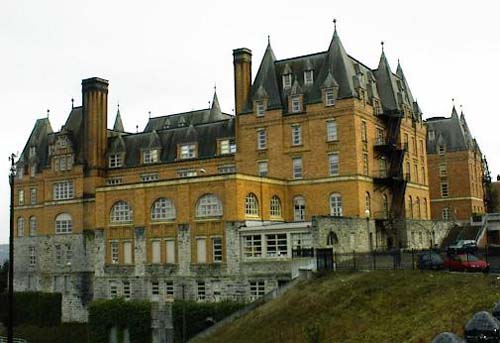
This site also contains an explanation of how such a splendid thing came to be a high school.
"The Brown Castle" is home to over 1700 students. Originally designed to be the Northern Pacific Railroad Tourist Hotel, construction began on the structure in 1891. The depression of 1893 caused the company to abandon work on the structure before it was completed. After being boarded up for a number of years it was acquired by the Tacoma School District. In 1906, Tacoma High School, as Stadium was then called, opened its doors to 878 students and 38 teachers. Renamed Stadium High School in 1913, the Brown Castle has been host to many historical figures, including Presidents Teddy Roosevelt, Woodrow Wilson and Warren Harding, presidential candidate William Jennings Bryan, World War I hero General John "Black Jack" Pershing and John Philip Sousa's band. The Brown Castle, a registered historical landmark, is a source of pride for the students, parents and staff of Stadium High School.
Presumably "being host" means they were guest speaking, yes? If so, not bad.
For my money, this building, despite even the presence of Julia Stiles, was the true star of Ten Things.
Interestingly, there are quite a lot of websites about Tacoma High, but none of them seem to make much – or indeed anything - of the fact that their building was in Ten Things. It's almost like it's a policy or something to pretend it never happened. Would this drum up business of a sort they don't want? Does Hollywood itself make it a condition of use that you don't brag endlessly about what their locations "really" were? Odd.
Anyway, it's a magnificent pile. I was not a bit surprised to learn that it was modelled on a French chateau, indeed I could tell that just by looking. It reminded me strongly of the (also French chateau modelled) Royal Holloway College, which is near where I was raised, in Englefield Green, Surrey.
RHC is even more splendid than Stadium High, but it isn't a school. What is the world's most architecturally splendid school, I wonder? Any suggestions?
Last week I was reminded that I possess a book called A History of Reading, by Alberto Manguel. I possess it but have not yet read it. Like many of the books I buy, this one was remaindered and thus obtained very cheaply, rather than something I deliberately went out to find, and when I got it home I put it on the pile of other such acquisitions and forgot about it. It was only some hazardous looking shelving that made me move it from A to B and while doing that to realise again that I own it. I flicked through it again, much as I must have done in the remainder shop, and it looks very promising.
Looking for something interesting to pass on to you people, and for myself to learn about, I naturally went to the chapter entitled "Learning to Read". In it, on page 71, I found the following delightfully tasty morsel of historical knowledge:
In every literate society, learning to read is something of an initiation, a ritualized passage out of a state of dependency and rudimentary communication. The child learning to read is admitted into the communal memory by way of books, and thereby becomes acquainted with a common past which he or she renews, to a greater or lesser degree, in every reading. In medieval Jewish society, for instance, the ritual of learning to read was explicitly celebrated. On the Feast of Shavuot, when Moses received the Torah from the hands of God, the boy about to be initiated was wrapped in a prayer shawl and taken by his father to the teacher. The teacher sat the boy on his lap and showed him a slate on which were written the Hebrew alphabet, a passage from the Scriptures and the words "May the Torah be your occupation." The teacher read out every word and the child repeated it. Then the slate was covered with honey and the child licked it, thereby bodily assimilating the holy words. Also, biblical verses were written on peeled hard-boiled eggs and on honey cakes, which the child would eat after reading the verses out loud to the teacher.
I used to be scornful of such primitive rituals. But being by nature a lazy person, I have learned a profound respect for the tricks we can all play on each others' – and on our own minds – to get us to remember things, and concentrate on things, and generally to apply ourselves to things. The mind thinks symbolically and metaphorically. So, devise a metaphor to get your point across to it. Leaders of armies know this. Priests most definitely know it. And so do good teachers, I suggest.
Some therapists also know it. Apparently, although I can't recall where I read this, if you are having a recurring nightmare, a way to diminish your chances of suffering from it in the future is to describe it as best you can on a bit of paper, perhaps with a verbal description, perhaps with a picture. Then, set fire to the picture and destroy it. Apparently the brain is, sometimes, satisfied with such subterfuges. Matter attended to, it says. Message received. Fine. On with other things. (And no more nightmares.)
If on the other hand, the image thrown at it is pleasurable and memorable, it makes that connection to, and keeps reminding you of it.
The message here is: reading tastes really nice.
Could this little scenario be part of the reason why Jews have tended, over the centuries, to be so well educated? I should definitely guess so.
Also, I think the above description might throw a little light on the question, which I found myself asking yesterday, of why the children in the picture I posted here yesterday (see immediately below) are all so beautifully dressed.
Michael Jennings did a posting about the surprisingly long history of colour photography, and I put a bit of it on Samizdata and asked about the very early Russian colour photos Michael mentioned. A commenter immediately referred us to the photographs of a certain Sergei Mikhailovich Prokudin-Gorskii.
I found one photograph with an educational theme. It's called Group of Jewish Children with a Teacher:
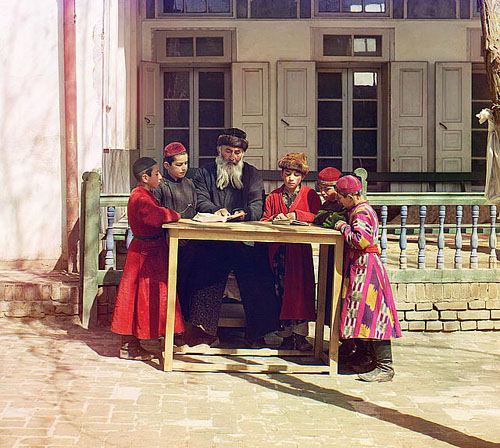
This photograph was taken in Samarkand in 1911.
Yesterday I got an email from Jackie D alerting me to the nonsense that Cecile Dubois is having to put up with at a her school for the crime of disagreeing with affirmative action, and I did a posting about it on Samizdata. Jackie has about this on her blog.
I'm not any sort of qualified or professional teacher, but surely encouraging or even tolerating mockery of an individual pupil by the rest of the class merely because of what that individual has said crosses some sort of line.
I agree with the Samizdata commenter who said that the teacher is not likely to change her opinions about affirmative merely because of all this transatlantic hullabaloo, but that isn't the point. The point is that education is not just about learning things, but about learning how to learn things. And one of the ways you learn how to learn things is you learn how to argue about things. You do this by mustering factual evidence, by examining and criticising assumptions, by examining and criticising false deductions being made from these assumptions, and so on. You learn the truth about things by learning how to be reasonable about things. If you are a good teacher you do all this yourself, and thus set a good example to your pupils. As it was, Cecile was the one setting the example. I think this not because I happen to agree more with Cecile's opinion about affirmative action than with that of her teacher, but because Cecile seems to have been the one doing the rational arguing, while the teacher was using only ridicule and intellectual gang warfare.
Speaking of intellectual gang warfare I wish I hadn't called this teacher as a quote Grade A Bitch unquote. That was very unreasonable and impolite.
The comments at Jackie D's are particularly worth reading because they don't just blow off steam, the way I did at Samizdata, but also hint at what is going to be done about it all. Cecile and Cathy are "going over to the principal's house for a small party today …". I sincerely hope that all is settled reasonably satisfactorily and that Cathy is able to proceed with her studies at school without too much further grief.
As Jackie D says, Cecile impressed and charmed all of us who met her in London last December, and Cecile's various comments yesterday and today impressed me some more. Some fairly harsh things were said about the appearance of her blog, about the difficulty of reading it, and so forth and so on, by some other Samizdata commenters, things which under the cicumstances could have been phrased a whole lot more politely. This wasn't at all what I had in mind when I asked people to comment on Cecile's predicament in a way that was supportive and encouraging. I mean, you're in a fight with your teacher and they're calling you a racist, and then some guys on a faraway blog tell you that your blog needs a redesign and you need to get a grip on html and your text is all too jammed together, etc. etc.
That's the trouble with bad situations like this. Tempers rise (including mine I'm afraid), invective is exchanged, others perhaps feel that too much fuss is being made rather too fussily and fuss some more.
But now get this. Whatever Cecile may have thought about these impolite complaints about her blogging arrangements, all that she actually said in reply was: you're right guys, my blog could use some improvement along the lines you say.
Classy. Whatever seems to happen to Cecile, or to be said to her or about her, she just keeps right on learning.
On Samizdata I called her Cecile du Bois, following Jackie. I now suspect that the correct spelling may be Dubois, and will go with that from now on unless authoritatively instructed otherwise.
Meanwhile here is a picture of (L2R) Cathy S, Jackie D and Cecile D, which I took at the Samizdata blogger bash last December: