
I seem to be focussing on movies about education a lot just now. I'm not the only one. Professor Glenn Reynolds has been watching Spellbound, the documentary movie about a spelling competition in America:
And that's another thing that struck me: It is a cliché to say that all the contestants in a national competition like the Spelling Bee are winners, but it's true. Watching these kids, I knew that they would all do fine in life. The qualities of focus, discipline, perseverance, and coolness under pressure that such contests require aren't the stuff of many movies about adolescents. But they serve people well later in life, as I'm sure these kids will discover. It's nice to see a film that makes that point, too.
And in his next and latest MSN column he explicitly links this to the quality of US education.With characteristic generosity, Reynolds includes links to other education bloggers (by the way that is not a snide way of complaining that I got excluded – this blog would not have been appropriate for the Prof's purposes):
There are a lot of educational bloggers who cover these kinds of topics in a lot more depth than I can. Joanne Jacobs (from whose blog these examples come) and Kimberly Swygert are two good examples, and their blogs have links to many more. You should also look at Erin O'Connor blog, Critical Mass, which does the same thing for higher education.This stuff matters. America is richer than the rest of the world because we have smart people who work hard, under a system that encourages them to do so by letting them keep (most of) the fruits of their labor. But America's wealth isn't a birthright. Like our freedom, it has to be earned by each successive generation. It can't be protected by legislation, it can only be protected by hard work.
Part of that hard work lies in educating the next generation. It's pretty clear that we're dropping the ball in that department. Instead of worrying about outsourcing, maybe we should be worrying about that.
The examples from Joanne Jacobs were quotes from other people.
Anyway, is America dropping the ball? It doesn't look that way to me, but maybe they are. Certainly these Indian computer programmers have got them scared. Anyway, the answer is for the American home-schooling movement to rise up and conquer the entire country.

It seems that wherever you look, you find good news about India, and about India's economic development. That India is now busily taking computer jobs away from Americans has been one of the big world economic stories of the last six months.
Here's more news of India pushing ahead, this time in the form of an educational satellite:
BANGALORE: Teaching over 20,000 students at a single go is no mean task. But making it possible and making classrooms barrierless will be India's Edusat – the world's first dedicated education satellite to be launched by India.A pilot project of Edusat, that will provide satellite-based distance education, was launched in Karnataka on Wednesday.
While Edusat (Gsat-3) is to be launched in June this year, a pilot project has already been launched to test its efficacy. It will presently run on the Insat -3B, already in orbit. Chief Minister S.M.Krishna launched the pilot project in Bangalore on Wednesday with a live conference across Mysore and Bellary.
In the first phase around 70 engineering colleges of the Visveswaraiah Technological University (VTU) will be linked to multicast interactive multimedia.
I know, I know, a "Chief Minister" launched the damn thing. But that doesn't necessarily mean that he will be in charge of it. After all, the Indian public sector doesn't yet have the silly money to waste that is the basis of all the West's educational failures nowadays. With luck, there'll be plenty of greed and selfishness involved in the management of this new wonder gadget.
How soon before the Indian education business goes global, by which I mean so global that it becomes the next big economic story about how India is gobbling up the universe?
What a blessed change this all makes from the days when the only news that ever came out of India was about misery and starvation.
UPDATE: India has just bought itself a new aircraft carrier. From Russia, which tells you who's on the up and who isn't. Well, second hand. Pre-owned, as my video store calls it.
I'm very fond of these short biographies that they do nowadays. If you can have short stories, why not short summaries of great lives? But for Brian's Education Blog purposes such books can be tantalisingly insufficient. That Lenin book I quoted from yesterday is a foot crusher if dropped, or it would have been when it first came out in hardback. Which is why it went into such fascinating detail about the nuances of the man's education. Christopher Columbus by Peter Rivière, on the other hand, one of the Pocket Biographies series done by Sutton Publishing, is only 111 pages long.
So this is all it says (in paragraph one of Chapter One, "The Early Years", on page 8) about the education of its hero:
Christopher Columbus was born in Genoa in 'about 1451. His father, Domenico, was a weaver, and his mother, Susanna Fontanarossa, also came from a weaving family. We know of a sister, Bianchinetta, and two younger brothers, Bartolome and Diego, who were to be his companions and supporters throughout Us life. He received little in the way of formal education and the claim that he attended the University of Pavia, where he is meant to have studied geography, astronomy and geometry, is almost certainly not true. If later in life he was recognized for his knowledge of these subjects it was because he was self-taught. As a young bov he was engaged in his father's business, although at an earlv age he started going to sea. This was not altogether surprising since, along with Venice, Genoa was the great trading city of the Mediterranean.
And with that Columbus immediately sets to and discovers America, or whatever it was he actually did to it (see Introduction).
Still, for those who prefer short postings …
Incoming email:
Brian,I am a recently retired computer analyst (20 years).
I would like to teach but don't want to get involved in the public school mess.
My question to you is: Is there a way I could earn any income by teaching
home schooler's technical computer subject material?Or: Is there some other way to earn money thru home schooling, for example, writing course material about computer related topics?
This is an idea I had but I know nothing about home schooling except that it is becoming more popular and will probably continue to do so if the public schools don't revamp the education system.
I would appreciate any ideas you may have.
Sincerely, Michael Hansen
Ideas and responses anyone? I should guess that this kind of knowledge is now swilling around the Home Ed movement like an ocean and no one is going to pay a cent for it. But what do I know? The Agony Midwife posting system has worked well in the past, where I put up the Dear Brian letter, and my commenters deal with it. So maybe something good will happen with this one.
If my scanner worked better I would probably do more postings based on the early lives of celebrities. I should do more anyway, because they are interesting to read, I think.
They can also be very interesting to do. Today, for instance, I was rootling about in chapter one of Adam B. Ulam's book, Lenin and the Bolsheviks (first published as The Bolsheviks in 1965). Did you know that Lenin had an elder brother, Alexander, who joined in a terrorist plot to assassinate the Tsar and who was hanged when Lenin was seventeen? Maybe you did, but I didn't.
Ulam then describes (p. 19 of my 1975 Fontana Library paperback) what was happening with Lenin's education while all that was going on:
While Alexander was awaiting first the trial and then the execution, Lenin was finishing his eighth and final year in the Simbirsk gymnasium. Graduation from high school was, for a European adolescent, a formidable and often a traumatic experience. It required not only a successful completion of what corresponded to the American senior year of the school, but also in addition a special examination in several subjects. This examination, the so-called "test of maturity", consisted of written and oral questions and exercises prepared not by the local teachers but by the ministry of education or by the professors of the regional university. Nothing was spared to endow the occasion with awe and tension. The strict secrecy about the content of the examination, the barricaded rooms where it took place, the virtual impossibility of beginning professional training if one failed a subject, make the most strenuous American and English academic tests appear innocent and relaxing in comparison. Nervous breakdowns were not uncommon among the students, most of whom were, after all, not older than eighteen or nineteen.With the earlier noted exception of logic, Lenin completed his high school course with the grade of "excellent" in every subject, including religion. The high school certificate included also such categories as "behaviour in class", "interest in studies", etc. In all these respects his conduct was adjudged "exemplary". The final written examinations took place in the week of his brother's execution. Lenin passed them with the highest distinction, being awarded the gold medal of the Simbirsk gymnasium (both Alexander and Anna [Lenin's parents – BM] had received the same award) as the first student in the class.
It makes you wonder whether all the would-be Al-Qaeda suicide bombers whom the Americans are now hunting to death have younger brothers, and if so, what they might get up to in the future.
A different slant on the obligations of adults towards their children to many of the usual slants you hear nowadays:
In a nutshell, Dr. Laura believes that many of the aspects of adult life that I had always considered complicated and messy and finely nuanced are in fact simple and clear-cut; that life ought to be neatly fitted around duty and responsibility rather than around the pursuit of that elusive old dog, happiness. This is what makes her the most compelling advocate for children I have thus far encountered, because the well-being of children often depends upon the commitment and obligation of the adults who created them. If you want to know whether the divorce culture has been a disaster for children, tune in to the Dr. Laura show one day. The mainstream media have a cheery name for families rent asunder and then patched together by divorce and remarriage: they are "blended families." But the day-to-day reality of what such blending wreaks upon children is often harsh. The number of children who are being shuttled back and forth between households, and the heartrending problems that this engenders in their lives, is a sin. Every June, Dr. Laura fields multiple calls having to do with transporting reluctant children across vast distances so that court-ordered visitation agreements can be honored. Whereas an article in Parents magazine or the relentlessly upbeat family-life columns in Time might list some mild and generally useless tips for dealing with such a situation (have the child bring along a "transitional object," plan regular phone calls home, and so forth), Laura throws out the whole premise. What in the world are the parents doing living so far away from each other? One of them needs to pick up stakes and move. "I can't do that," the caller always says. "Yes, you can," Laura always replies, and when you think about it, she's right.
This being the Dr Laura in question, Dr Laura Schlessinger, who is apparently a big name in the USA. The book review article quoted from above is in the Atlantic online, and the writer of it, Caitlin Flanagan, reckons that Dr Laura is better at broadcasting than she is at book writing, but that her old fashioned ideas about duty towards children, and duty generally, are a breath of fresh air.
The trouble with denouncing divorce as a bad way to bring up children is that if you do it, or even (as here) side with someone else who is siding with someone else who is denouncing it, you risk offending friends, and for that matter relatives. Five persons in one or other of these categories spring to my mind immediately, and further thought would surely throw up as many more. But surely it's true. The best way to raise kids is for them to have a mother and a father, who live together or failing that very close to one another and who get along, or who at least do a reasonable job of pretending to.
That doesn't mean that the government should mandate this method and forbid all others. It merely means that this is what tends to be best and what parents should all do if they can, in the opinion of this pulpiteer. Yes, in thousands upon thousands of cases these single parent households are better for the children than those regular ones, and yes again, gay people can't do regular families very easily (although I'm sure that many gays fake family regularity with extraordinary completeness) and shouldn't be legally prevented from doing their own alternative versions of families. As I have said recently in another place, politically I'm libertarian, but my moral and behavioural preferences and aspirations are conservative.
Here's an interesting way for a school to get better exam results: make clever pupils sit the exam instead of stupid ones.
KUALA LUMPUR Jan 26 – The Kedah Education Department would investigate allegations that a school in the state had substituted candidates during the 2002 Ujian Penilaian Sekolah Rendah (UPSR).Education Ministry Director-General Datuk Abdul Rafie Mahat said Monday the State Education Department had been instructed to conduct a detailed investigation with regard to the allegation.
"The Ministry views the matter very seriously. We want to investigate allegations that Sekolah Kebangsaan Pulau Chapa in Kedah had substituted weak pupils with top Standard Five achievers to sit for the UPSR examinations," he said in a statement.
Well, if you can have substitute teachers …
Talking, as I was in the previous posting, about charismatic teachers and their charming pupils in the movies, this looks like it could be fun. Yes folks, it's School of Rock, starring Jack Black, who I thought was great in High Fidelity.
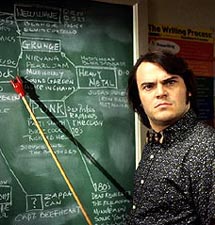 Here's a synopsis:
Synopsis: Dewey Finn is a hell-raising guitarist with delusions of grandeur. Kicked out of his band and desperate for work, Dewey impersonates a substitute teacher and turns a class of fifth grade high-achievers into high-voltage rock and rollers. The private school's uptight and skeptical head, Principal Mullins, watches on as the 'new sub' preps the kids for Battle of the Bands.
It's nice that he's called Dewey – a little educational philosophy in-joke there.
Reviews seem to be mostly good and I will definitely see this at some point, although probably only when it comes out on DVD in Britain. Most of the reviews say that it is good old-fashioned frothy Hollywood comedy with its heart in the right place and saved from schmaltz by being well and winningly performed.
And when I do see School of Rock I will seek out the serious educational ideas that are sure to be contained in it, and report back to you all.
On Saturday evening BBC4 TV showed Etre et Avoir, Nicolas Philibert's documentary about Georges Lopez, the French teacher in a primary school in the farming country of the Auvergne. It has been a huge surprise hit in France and is now being given award nominations and awards over here, and you can entirely see why.
There was one of him and about twelve of them. The children all got to know him well, he got to know all of the children well, and we got to know all of them, him and the children.

If there is to be orthodox, compulsory education, then this is clearly the kind of thing it ought to consist of. Georges Lopez was firm, fair, kind, attentive, and clearly loved his charges in just the way that you would want a teacher to do. He taught the 3Rs with care and certainty. He socialised with them and taught them manners, and was never himself anything but polite and respectful. He took them on trips in the surrounding countryside.
When one of the boys was distraught about his father's severe health problems, there was Georges, talking him through it, offering salient philosophical advice and comfort. ("We try to stay healthy, but then illness comes, and we must cope with it.")
I tried to sustain all my usual objections to educational compulsion, which this most definitely was despite the kind and considerate manner in which it was being administered, but honestly, I couldn't sustain them. Given the alternatives offered by their actually existing environment, this was the best deal that these children were going to get, by far. I couldn't blame Georges for the rules of his culture and the times he lived in. He was doing his best, and his best was very, very good.

There was one rather scatter-brained and mischief minded little kid with a splendidly photogenic face (he is now a celebrity, you can bet) called Jojo, who wasn't naturally bookish or logical, more your imaginative, romantic type. There was a lovely scene where Georges got Jojo to understand that there was no limit to how high numbers can go. ("Can you have more than one hundred? Can you have two hundred? What about three hundred? A thousand? Two thousand? Three thousand, … ten thousand, twenty thousand, … a million, two million, three million?" Jojo dutifully supplied the answer that Georges was looking for, which was "Yes you can", but was rather bored by it all, and would clearly have preferred to be talking about the interesting little human drama that was happening over the other side of the room. And eventually, George did defer and switched to talking about that drama. But not before he had stretched Jojo's brain like a piece of chewing gum. And of course, in the final scene, when they were all saying goodbye, Jojo was among those most sorry to be leaving. He loved Georges more than almost any of them. At least Georges, although firm with him, was also kind and gentle. I bet lots of others weren't nearly so patient when they were telling Jojo what to do.

The other scene that stuck in my mind was when another kid was filmed doing his homework, surrounded by his entire family. Mum, Dad, a brother, and an uncle I think it was. On and on it went, with Dad in particular sweating away at the mysteries of higher arithmetic. The camera stayed absolutely still. It looked like a Rembrandt. Boy and family doing homework. Beautiful.
A particularly pro-French thought. When they were all saying their final goodbyes, they all said goodbye with the ceremonial three-times-over left-right-left French kisses, boys and girls alike. My own bit of culture contains no such ceremonial interchange. This one was peculiarly appropriate for this particular moment, and very flexible. It could be distant and correct, like getting a medal from the President, or affectionate, as between members of a family. You could see Georges adapting the atmosphere to suit each child, with the last boy being particularly formal and distant. ("Au revoir Monsieur!")
There was one girl to whom Georges made a point of not saying a final goodbye. She was due to go to another much, much bigger school, and she was distraught. She was seriously bad at communicating, with anyone, but was just about okay with Georges and the small classroom with its small number of other children. She sat with Georges, rocking with repetitious grief and fear at the horrors to come. Georges did most of the talking, combining firmness and gentle concern as best he could, expressing confidence, while offering the poor girl the chance to come and visit Georges and tell him how she was doing. Okay? "Oui."
With a little bit of luck, it helped. And quite possibly this talk made all the difference to her entire life to come. It wouldn't surprise me.
Georges himself is (and I guess it's was by now) to say goodbye to teaching soon after this film was in the can, and when he told his kids about that they were not best pleased. A lot of the appeal of this film is the feeling you have while watching it that this is a fast vanishing world. This kind of kindness, politeness and personal attention may soon be a thing of the past.
After the film was so successful, there was then a huge row about how much of the money that the film so unexpectedly made ought to go to Georges Lopez himself. A lot, was Georges' opinion. I don't know how that all finished, but in any case that's a different story.
I'm glad about the pictures decision. I can feel it working already.
There's no doub that my Culture Blog has been a whole lot more fun than this one in recent days and weeks, and part of it is pictures. I've mulled it over, and I've decided I'm going to put pictures here too, as and when it suits. And this one is fully worthy of the honour of being Brian's Education Blog Picture Number One:
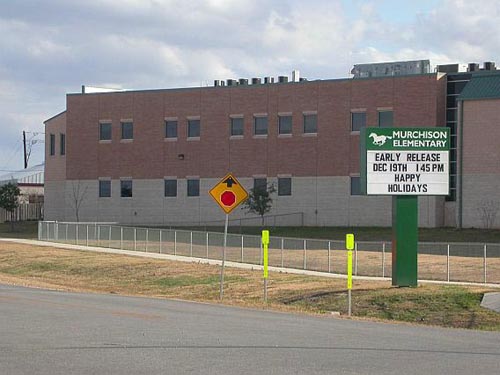
This is the Eyesore of the month for January 2004, at this site of that name.
Of this eyesore, James Howard Kunstler says:
Hmmmm. This typologically ambiguous building in Pflugerville, Texas (just north of Austin) is the K-through-6 medium security education facility. It's encouraging to know that the inmates were slated for "early release" this year. Ask yourself: what kind of citizens would an institution like this produce? And where do they go from here?
My thanks to Michael Blowhard for the link to this.