
More from the Department of Count Your Blessings, from Nigeria.
Leader from the Vanguard of Lagos. Quote:
Poor funding and inept management of schools have, according to NAPTAN, resulted in acute classroom over-crowding, non-existence of library facilities and poor remuneration for teachers, which consequently dampens their morale.Worse than this, however, is the pervasive instances of certificate forgery, examination malpractices, cultism, murder, arson, gangsterism and other criminal tendencies in the educational system. That is the extent of the havoc wrought on schools by a succession of shortsighted leaders.
What is to be done?
But, before the country can record any progress in her educational system, all stakeholders in education must realize the pervasiveness of value disorientation in the system, and appreciate the need for a re-awakening of appropriate values to wean the society back from the precipice of a free fall. A re-awakening of socially acceptable mode of conduct in students, parents and teachers will put an end to cultism, examination malpractice, sexual permissiveness, and all other vices that have, over the years, been militating against the educational development of the nation.It is only when peace and security reign supreme in our schools that the quest for their rejuvenation can be realised.
Envious eyes are caste towards Japan. More spending is needed, to provide technological education fit the modern world. Things must be done better. Everyone must behave better.
In other words: they have no real idea what the hell to do.
Good luck fellows. You're going to need it, by the sound of things.
As it says at the top of allafrica.com where I found this: "There's no place like Africa …" Maybe just as well.
And as has been said here before, using the word "stakeholders" won't do you a bit of good.
I see that in my report from the day before yesterday of that VRH refreshment meeting, I really left out the most important thing I learned, which is that reading is not the sole purpose of VRH. Paul The Boss even said that he somewhat regretted the title of the organisation, Volunteer Reading Help, because it missed out other important things, like children just talking, with an adult, and just becoming more confident. Once they see the basic point of words, and can say them confidently, then the next step, of reading them and writing them, comes far easier.
Paul The Boss even used a word I had never heard before – "oracy" – which apparently he heard Parliamentary Under Secretary of State for Schools Stephen Twigg use in a speech about a year ago. Paul The Boss suspected Stephen Twigg of having made the word up, or that the word was at least something made up by New Labour. But he liked it anyway, or he wouldn't have mentioned it.
So, is oracy a real word? You be the judge. I have the strong impression that we have the education academics to thank for it, and that before 1990 it definitely wasn't a word. But one thing's for sure, which is that Stephen Twigg did not make it up.
However, the fact that someone like Paul The Boss finds this word useful makes me respect it, despite its likely recent academic origins. What Paul The Boss has in mind is a general confidence with words, spoken as well as written, although whether the academics mean exactly that by it I don't know. And we VRH volunteers are there not just to get our charges reading, but, if that fails, simply to get them talking. Confident in speaking with an adult. Used to the idea that words can communicate, that communication, indeed, is possible.
Associated with this is an ethic of voluntariness. We aren't there to compel these kids to do anything they don't want to do. If they want to play games, fine, that's what we do. If only because playing games does often involve reading in various ways, as was the case today when Boy Two and I played a card game that involved him reading the names of soccer players and their countries.
What separates all this from the aimless chaos of a badly run primary school is that each child has our undivided attention for the duration of the session. Just sitting and doing nothing and getting bored, it is absolutely not.
Category: Brian's brilliant teaching career • Education theory
 [2]
[0]
[2]
[0]
A posting today at the SAU blog is by one of my favourite educational commentators, . It is basically a written down version of what he said on this occasion.
Gilbert supplies his own summary:
As a consequence of my encounter with the state education system, I believe that there are five policy changes that might begin to solve our country's educational problems.1. Take the education system out of state control;
2. Allow schools to set their own admissions policies;
3. Disband the National Curriculum;
4. Introduce a standardized reliable series of external tests; and
5. Offer improved child care facilities to the parents of very young children.
That shouldn't take long!
And while you're at the SAU blog, check out Elaine Sternberg's review of Alan Bennett's play The History Boys, now in repertory at the National Theatre.
While embedding the links into the above verbiage, I noted that the samizdata piece I did after attending Gilbert's SAU talk, and the Bennett play, are both, centrally about the matter of the measurability and the immeasurability of education. Bennett argues that the immeasurable shouldn't be neglected, and I argued that immeasurability is no excuse to put the government in charge of everything.
Today, in need of a little face-to-face guidance in the matter of my Paradise Primary activities, I rang the London headquarters. (I see two boys, twice a week for half an hour each, one-to-one, encouraging them to read, talk, be happy, etc.) I asked for Paul The Bo, but instead spoke to the equally helpful Lady Assistant. And it turned out that they had a refresher afternoon for volunteers this very afternoon. Would I like to attend that? I could fit it in, and I did. The gathering consisted of Paul The Boss and four volunteers, me included.
I found both the event itself, and the personal chatting with Lady Assistant on the phone, and then with Lady Assistant and Paul The Boss before the formal proceedings began, both useful and encouraging. Basically, they said, I need not worry too much about whether Boy Two is proving a bit of a "challenge". I should just carry on carrying on, doing my best, and it would almost certainly help, they said. Fine by me.
(Boy One seems to be doing very well, although as we bloggers often say: what do I know? You do your best and hope for the best, with VRH stuff as with so many things.)
From one of the other volunteers I learned that there is at least one way that I have things very easy, which is that I do my stuff in the same place in Paradise Primary every time. She has to duck and weave and find a free spot in her much overcrowded school, and never knows from one gig to the next where she will be, or where the kids will be that she is supposed to be helping. The school knows the problem but can do nothing about it. I just go in and am started within a couple of minutes, in the same place as always. Count your blessings Brian.
Apart from the somewhat tedious travel, which I have yet to get systematised properly, my only other complaint (a minor one) is that I have yet to develop much in the way of a relationship with the school staff. They are very kind and polite, but mostly they just let me in and let me get on with it. They often thank me profusely, but it's hard to tell how much difference I am really making in their eyes. Trouble is, they seem too busy for me to feel comfortable really asking them things, plus it probably doesn't help that I go there towards the end of the school day when everyone is probably eager to be off home, in circumstances of maximum excitement and confusion.
Paul The Boss suggested that if I looked at the Paradise Primary website (by the way Paradise Primary is not this place and nor is this its website) for future school events I might invite myself to, but I couldn't find anything.
Be patient, said Paul The Boss. In fact said everyone (every other volunteer having been at it longer than me).
Paul The Boss also advised that with Christmas approaching, any primary school is likely to be in a more than averagely fraught mood just about now, and that if I just keep showing up until the end of the term, with no fuss, that would be best. Leave all that developing-increased-contact-with-staff stuff until the new year, when things will probably have calmed down a little.
A most helpful event. Basic message from Them to Me: relax, be patient, you're doing okay.
The always useful Adriana (of this fame) emails with the link to this, the technical nuances of which I can't say I understand very precisely, which in its turn links to another posting, about a University … saying no to blogging as an educational technique. Right? (Or maybe just pissed off with an insubordinate subordinate. It all rather reminds me of this.)
This bit, however, I do understand:
… Ubiquitous networking and portable devices provide a backchannel environment that changes discussion in the classroom in a profound way. …
Any teacher who sells himself as the fountain of knowledge (rather than as a person who introduces his pupils to the fountain and gets them interested in it and drinking of it, without pretending to control it or to know all of it) is asking for trouble nowadays, and has been for many years, surely. I mean, surely this is problem that has been with teachers for as long as their pupils were able to obtain their own choice of books.
Nevertheless, the latest wave of electronics, which now makes information nearly ubiquitous, like oxygen, has altered the balance of power. To make sense of books, it helps a lot to have teachers who explain them. This electronic stuff now explains itself.
The last big lurch of this kind that happened that I can remember was when TV took off its black bow tie and went into colour, and when rock and roll got into its stride. But at least the clever ones remained dependent upon their god almighty teachers. But now here's this damned Internet, which is TV and rock and roll for the scholarly types, for the university students. Tellly and rock and roll destroyed the authority of the average school teacher type. Now, the Internet is destroying the authority of the average university professor type, whose interpretations and simplifications are now just a few among thousands that the clever student can access.
Portable devices have a particularly revolutionary effect on education, because pupils, who tend not to have fixed work places, so this turns the world into being totally computerised, having only a moment ago been not computersied at all. So portable computer power turns computers into a permanent threat to the "authority" of any teacher silly enough to regard them as an enemy, rather than as one of the objects of the whole exercise.
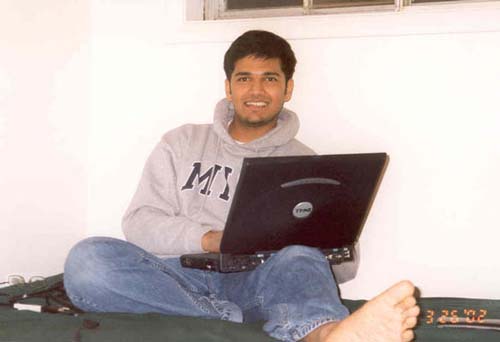
And blogs will also have particularly revolutionary effect on education, because they are the friendly front end of the Internet. Like a good teacher, they help you to find your way through the infinity of the information that is now out there. They are a threat to editorial writers of the traditional sort. And they threaten teachers who want to go on deciding what everything means on behalf of their pupils, instead of helping them decide for themselves.
Gratuitous pictures, of happy student above, which I found here, and of kid with laptop computer, being helped by a nice teacher, which I found here.
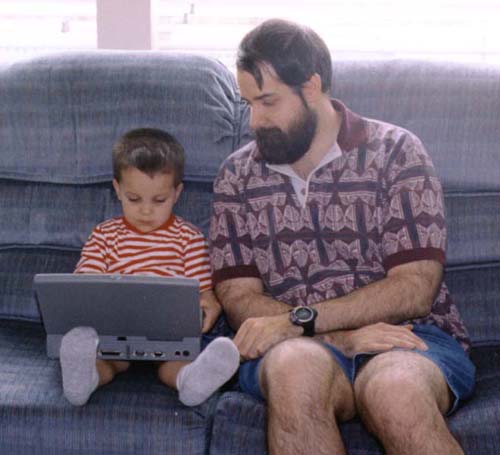
And, by connecting the kids to each other, never mind to the big wide world, networked computers are the ultimate note handed around at the back of the class, and as such another gigantic kick in the gonads for the orthodox teacher from whose sacred mouth and white-board all wisdom is still supposed to flow.
In sensing some of this, if it did, this university was definitely on to something.
This is very entertaining:
Ofsted, the government's education standards watchdog, has admitted that parts of an inspection report given to a top Birmingham school were copied from a report on another school more than 100 miles away.Lordswood Girls' School - judged in government league tables to be the best in the country for improving pupil performance - is planning to sue Ofsted after discovering that two pages of a critical review were identical to an earlier report on Parkside School in Bradford.
'When I realised my school's report contained judgments on areas that the Ofsted team had not inspected during their visit, I became suspicious,' said Jane Hattatt, the headteacher at Lordswood. 'I thought: "What would a stupid child have done if they wanted to pretend to have completed work they had not done?" [So I] typed key phrases into the internet to find where they came from.'
The fact that an Ofsted report contained inaccurate information from another school will be highly embarrassing for the institution. Parents looking for the best schools read Ofsted reports closely and a good report can lead to a school being over-subscribed. Bad reports can have the opposite effect.
By the look of things, this is a case of sheer incompetence, rather than of anything more malevolent. However, it's not the kind of thing you want from school inspectors, is it?
See also this posting here.
The Telegraph reports on an interesting, and if you are the worrying sort (as I am basically not), :worrying report about the rise and rise of stage schools:
Some of the most famous actors and actresses in Britain are warning parents not to send their children to stage school because they say that many provide poor training and exploit pupils commercially.The actors, including Richard Griffiths, Samantha Bond, Julian Glover, Paul McGann and Sam West, say that even children desperate to act would do better to complete a conventional education first.
The reason, they say, is that some stage schools are more concerned with making money than with teaching.
The actors' concern, which is shared by the National Council for Drama Training, has been prompted by a sharp increase in the number of full- and part-time drama schools catering for children, some as young as four.
An obsession with fame and popular culture generated by television programmes such as Big Brother and Pop Idol has been cited as one reason for the increase in the number of courses, and some schools have their own theatrical agencies. The theatrical directory Contacts 2005 lists hundreds of full- or part-time children's courses at fees of up to £7,000 a year.
Sam West, who starred in Howard's End and the BBC's Cambridge Spies series, said that many schools were little more than "glorified modelling agencies" which, at best, were interested only in children who would look good on television and could make it as presenters.
I wonder. Isn't the underlying truth here that almost nobody, statistically speaking, makes it as a successful actor, so no matter what you do to become an actor it will probably fail, and the more people try this, the more true this will be.
So the big question becomes, is actor training a worse education than "conventional education", and I'm not persauded that it's any worse. We are constantly bombarded nowadays with the claim that our economy is becoming less about making things and more about "service", and that's because it's presumably true. And is not "service" a lot to do with presenting yourself to others – audiences you might say – in whatever way will be most appreciated. Trade after trade nowadays, it is constantly said, is "all about presentation".
I reckon all those little failed actors might turn out to be just as useful as all the failed Sam Wests who now roam the earth, with their heads full of drama texts and just bursting to write essays about everything, of a sort that only other essay writers want to read, and not many of them because they are too busy writing their own essays?
I also think that there is a lot to be said in favour of children being exploited commercially much more than they are now. It's called work, and I think children become insufferable little drones if they do not do any of this. But, if they do do work, they ought to be paid, i.e. "exploited".
For many children, might actor schooling not be just a way to avoid the grind of regular education and to do something fun instead? This Telegraph report certainly suggests that there is great enthusiasm for these places. Also, it is probably better exercise, something which conventional education has been doing huge damage to in recent years.
More generally, I wonder what impact all these actor schools will have upon the wider culture. (Think about the impact that art colleges have had, for example on pop music. These are similarly useless places on the face of it.) What sort of things does actor training prepare you to do, assuming what you do will not be doing much in the way of normal acting in theatres, films, etc.? In the future, there will surely be entire new industries as yet undreamed of, that will make use of all these ever more widely dispersed drama skills.
For instance, what happens to global culture when it becomes as easy to converse on television, so to speak, as it now is to converse over the phone? Actor training will be quite a good preparation for that. As more and more of everyday life becomes like a performance, actor school alumni may actually find themselves at a competitive advantage.
Perhaps all these actors will fan out across the globe and become English as a Foreign Language teachers. Quite good ones, I mean. Teaching Indians and Chinese how to to TV telephoning to the white Anglosphere.
Just a few thoughts, from a useless essayist.