
Jeff Jacoby writes, of Arafat the monster:
Perhaps his signal contribution to the practice of political terror was the introduction of warfare against children. On one black date in May 1974, three PLO terrorists slipped from Lebanon into the northern Israeli town of Ma'alot. They murdered two parents and a child whom they found at home, then seized a local school, taking more than 100 boys and girls hostage and threatening to kill them unless a number of imprisoned terrorists were released. When Israeli troops attempted a rescue, the terrorists exploded hand grenades and opened fire on the students. By the time the horror ended, 25 people were dead; 21 of them were children.
I recall a comedy show once where there was a gag about someone nasty who had died, and they said: "Doctors describe his condition as satisfactory."
Or to put it another way …
This story reminded me that a century ago, one of the greatest criminal minds of the time was Professor Moriarty, Sherlock Holmes' great antagonist.
A criminal gang of professionals and academics led by a Sicilian professor defrauded the European Union of millions of pounds in a fake youth training programme, Italian police claimed yesterday after a string of dawn raids across the country.Among those arrested was the ring's alleged mastermind, Prof Salvatore Messina, 51, a Sicilian academic with the Université Paris 13 in France, who also lectures at the University of Palermo.
So what subject did Professor Messina … profess? Ideally, he would be some kind of (im)moral philosopher, of the sort for whom crime is merely the revolutionary impulse of a repressed class, in this case the professor class, striking back against late capitalist hegemony. Nothing so elevated, I'm afraid.
Prof Messina is president of the Permanent Observatory for Tourism in the Mediterranean (OPTM), and edits a quarterly entitled Sicilia, L'isola del Tesoro, (Sicily, the Treasure Island) which the OPTM publishes. The other six arrested were all described as being in Prof Messina's entourage, including a former assistant in Sicily's regional department for professional training.
Treasure Island! No doubt this magazine title was one of the clues that told the Italian police that they were onto something.
As higher education becomes bigger and bigger business, we can expect more stories like this, I fear. My hearties.
There is a fascinating piece in the Telegraph about a course that cures stammering:
In August last year, I attended my first session of the McGuire progamme, an experience I can only describe as liberating. The main focus is on learning a technique called "costal breathing". It involves using a different part of the diaphragm – the muscle below the lungs – to generate a deep, full breath, generating the power to push out the words.What makes the programme distinctive is that it is a speech therapy course run for stammerers by recovering stammerers. This creates a sense of honesty and trust: everybody in the room knows everybody else's biggest secret.
At the end of each course, all the students make a speech in front of hundreds of people. Difficult enough for most non-stammerers, this is a test of nerve, composure and technique. When I stepped down from the platform, the feeling of elation – the freedom of finally being able to express myself fully – was overwhelming.
This is how singers and woodwind players are taught to breath, if I am not mistaken.
Link to the McGuire Programme website here.
And here's another political row (see also this earlier posting) being fought out on the terrain of school history textbooks, this time the one between Taiwan and mainland China. China View says that Taiwan and mainland China share a common history, which is true. But China View stirs this truth in with the claim that therefore Taiwan simply cannot in the present or ever in the future be politically independent from mainland China, which is false.
I think a lot of the success of Lego is that when you read a report like this you don't only think: blatant marketing.
SINGAPORE : Southeast Asia's first Lego education centre opened in Singapore on Thursday.It features not only a galore of Lego blocks to teach basic physical science to pre-schoolers, but also a Mindstorms programme – which allows students to build robots - using the principles of mechanics.
The centre will cater to students from pre-school to teens and has tied up with local education provider Crestar to offer seven different curriculums ranging from design to physics.
So far, an estimated 800 students have signed up for classes which begin next month.
Four more centres are expected to be launched by 2007. – CAN
It is blatant marketing. Get them young, build brand loyalty, get them addicted. Yet despite all the obvious commercial calculation, this is not like getting kids addicted to potato crisps or hamburgers or rap music videos. Here, you feel, is a case where commerce and education, as claimed, really do go hand in hand. They really might be teaching some real design and some real physics here.
 As I ruminate upon education, I find myself attracted by a topographical model of education involving intersecting circles, like those diagrams they use to explain how the different colours come together to make TV work. There are three circles. These denote: the interests of the child, the interests of the child's parents, the interests of the child's teachers. When a proposed item of education occupies none of the circles, no worries, it just doesn't happen. When it occupies only one of the circles, there is conflict. When it occupies two, the third party tends to get bullied into line. The child has to do it, the parents have to put up with it, or a teacher is found who will provide it. Best is when all three areas overlap.
This Lego thing has the feel of being in all three circles. Your first reaction might be: this is only in a completely irrelevent fourth circle occupied by those dubious individuals who hover on the outside of education looking to further their own interests but to make nothing but trouble for children, parents and teachers. Junk food salesmen, sex fiends, etc. But here is a hoverer who has parachuted himself right into the middle of the intersecting circles.
Which of course makes it very clever marketing.
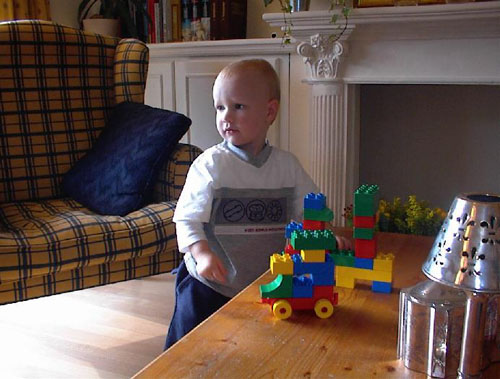
I found this Lego picture here.
From time to time I purchase a copy of the news digest magazine, The Week (although I'm afraid that link is only to puff telling you to buy it in paper form), and thanks to the November 6th 2004 issue I learned about an Asia Times article from last month about a toxic textbook which is being distributed in Japanese schools.
Says The Week, in its summary of this article:
If Japan, unlike Germany, has always been reluctant to take full responsibility for its crimes during the Second World War, says Tang Liejun, at least it used not to deny them. But that's what's being attempted in a new history book being distributed in Japanese schools. Far from acknowledging the rape and pillage carried out by Japanese troops, this "toxic textbook" insists Japan invaded its neighbours to "liberate" them from Western imperialists and to "bring prosperity to their peoples". By persisting in regarding this as a hostile occupation, China, Korea and other Asian countries show rank "ingratitude", the book complains. It calls into question the Nanjing massacre, in which Japanese soldiers raped and murdered 200,000 civilians, and fails even to mention the hundreds of thousands of Korean and Chinese "comfort women" forced into sex slavery for the invaders. We've given up expecting contrition from the Japanese, but this "ennobling" of their past barbarism is completely unacceptable. It might spare their children some "pain and guilt", but in the long run it will only perpetuate the hostility towards Japan felt by so many of its Asian neighbours.
The Asia Times article includes this quote from the book:
"It seems that up to now Asian people still mistakenly regard Japanese as invaders, [but they] risked their lives and cooperated closely with weak or strong peoples in Asia in fighting the Western big powers in order to advance the worldwide colonial liberation movement; Asian peoples' equating of Japanese with the Western imperialists is totally ungrateful and against morality, [since it was the Japanese] who came to their help and inspired them to get independence."
I know I keep banging on about the Internet and its effect on education, but it does seem to me that the Internet is bound to have an effect on little nationalised intellectual ghettoes of the sort that this textbook is trying to perpetuate and strengthen. As Tang Liejun says, the Japanese may never apologise, but it seems unlikely that it will be possible to keep them in universal and permanent ignorance of what it is their Asian neighbours are saying they should apologise for. They are bound at least to learn that their neighbours see things differently.
The BBC reports on a fairly typical piece of public sector failure, in this case of the inelegantly named UKeU. See also these earlier BBC reports, here and here.
The basic problem seems to have been that the people running this thing thought that a good educational idea (even assuming that this is what it actually was which it probably wasn't) is enough for the whole wants-to-be-educated world to come pounding on your door. But, in business in general, and most definitely in education in particular, there is a little thing called reputation. You have to have one of these, it has to be good, and it can take a while to establish it.
And the other problem, of course, is that shovelling stuff onto the internet and exchanging emails with students is no longer rocket science, and is being done by other universities. As Americans would say: wow, never saw that coming.
The attitude of the Minister who inherited this mess reminds me of those comedy sketches about maintenance men who say "Who installed this then?" when the answer is: "You did, mate." You, as in this government. You set it up.
Current Minister Howells says that the "marketing" was poor.
However …
... he would not call the failure of the project a disaster because he was interested in the lessons learned.
Ah. A learning experience.
Category: Computers in education • Higher education • Politics
 [0]
[0]
[0]
[0]
This has obvious educational implications, especially in an age of rich and competitive parents. (See the posting below about which are the world's best universities.)
Some neurologists recently have wondered whether their field is the next frontier in elective medicine. The specialty now tries to protect ailing brains from conditions such as Parkinson's disease or migraine headaches. But doctors' efforts one day may extend to normal brains."This is coming, and we need to know it's coming," said Dr. Anjan Chatterjee of the University of Pennsylvania.
Got you, Doctor.
As he envisions it, cosmetic neurology one day could mean not only sharpening intelligence, but also elevating other dictates of the brain – reflexes, attention, mood and memory. Studying for the SAT? Take this drug to retain more of those pesky facts. About to report for duty at the fire station? These pills will improve your reflexes. Here's the 800 number. Ask your doctor.These are not only theoretical musings. Last month in the journal Neurology, Chatterjee noted that some current drugs already may have many of these effects. In one study, for example, emergency-room patients given a memory-altering drug appeared to be spared some symptoms of post-traumatic stress. Another small study of pilots in flight simulators suggested that those taking medications for Alzheimer's disease performed better, particularly under emergency conditions.
Chatterjee reserves opinion but says the idea speaks to the basic purpose of medical practice.
"I'm not arguing that this is a bad thing, and I'm not arguing it's a good thing." Before doctors are caught by surprise, he said, they need to be prepared. "What I'm hoping to do with this is get people talking."
And if for some reason they can't talk, there is presumably going to be some kind of operation to fix that.
I had already started on this posting before I even got to the bit about getting people talking. So I guess here is a doctor who knows how the world works, as well as just the brains in it.
My thanks. Arts, letters and a lot else.
And (for the second time today) … a Times Online link, this time to a story about laptop computers.
Quote:
There are plenty of reasons for St Cecilia’s to be popular. Sheer newness and glossy, high-tech appearance for a start. Even the head teacher, Jeffrey Risbridger, admits that from the outside St Cecilia’s, with its large plasma screen flashing up the names of guests in the foyer, looks more like a plush new office block than a high school. But it is the school’s laptop policy that may be its biggest lure for parents and pupils.St Cecilia’s, building its way to a full complement of 900 pupils, currently has just 11, 12 and 13-year-olds on roll. But every one of its 300 pupils has their own laptop, picked up in the morning and used across subjects until the school day ends at 2.30pm. If they then want to stay on to complete homework the building is open – and the laptops are available – until 6pm.
The laptops are a vital part of a state-of-the-art information and communication technology (ICT) scheme in which the latest radio technology and extended battery power are used to avoid the need for cables. Every classroom is equipped with electronic whiteboards, upon which teachers flash up their lessons, consigning the old-fashioned handout to history.
As I have said here before (and I will have to dig up the link later because I can't now find it), this kind of thing only works if you have staff who are committed to making it work, as this school obviously does.
Nightmare scenario: this school is brilliantly successful, and is copied by other schools who think that flinging money at computer companies will guarantee success, even if the staff don't have a clue about how to use all their new toys, and think that the toys will rise up magically and do their job for them.
The bad news about this school and its laptops is that they can't be taken home and worked with there, because they would then be stolen by marauding gangs of less educationally advantaged youths. So I guess the next step is to fix it so that the pupils can access all the same material from their home computers, with some kind of networky thingy arrangement.
See to it, Professor Jeeves.
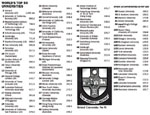 Times Online has a list of the top universities in the world, arranged in order of merit, first issued by the Times Higher Educational Supplement. I've copied it to my site so that it won't vanish, and you can read it by clicking on the diminished version here. I found it by clicking the graphic here.
Here is the Times Online piece about it.
Here's how the list was compiled:
Universities were placed in the table with the help of findings from a survey for the THES of 1,300 academics in 88 countries. They were asked to name the best institutions in the fields that they felt knowledgeable about.The table also included data on the amount of cited research produced by faculty members as an indicator of intellectual vitality, the ratio of faculty to student numbers and a university's success in attracting foreign students and internationally renowned academics in the global market for education. The five factors were weighted and transformed against a scale that gave the top university 1,000 points and ranked everyone else as a proportion of that score.
My first reaction on reading the list was "How real is this?", but that sounds real enough, even if it is weighted slightly towards what people think are the best universities, and they could be out of date, as well as just plain wrong of course. It will be interesting to see how things change, say, during the next five years. That's if they do this again.
This list will feed the frenzy of parents trying to bribe/threaten/cajole/beg/prostitute-themselves etc. for places for their worthy or worthless little darlings. "But Michigan is only thirty-first best!" Blah blah blah.
Here's who won:
Harvard, whose faculty members have won 40 Nobel prizes, emerged as the world's best university by a considerable distance, with second-placed Berkeley rated 120 points behind at 880.2. …
And here's how Oxbridge did:
… Oxford scored 731.8, slightly ahead of Cambridge on 725.4.
Here are the totals in the top fifty, broken down by country: USA 20, UK 8, Australia 6, Canada 3, Switzerland 2, Japan 2, Singapore 2, France 2, Hong Kong 2, China 1, India 1, Germany 1.
What hits me is (a) how large the Anglosphere looms, and (b) how badly continental Europe does. I would have expected Germany in particular to do a lot better. I guess chucking out all your Jews is not smart, higher-education-wise.
My beloved London, with 4 of the UK's 8, did particularly well. Hurrah.
More from this book.
Following on from the success, such as it was, of Firelight, Spielberg's next effort as a film maker was Amblin, and this, given that he had already made some movie industry insider contacts, got him the serious attention of Hollywood. So much so that Hollywood made him an offer which he did not refuse …
A couple of months later Amblin was ready for unveiling. Since the negative was held at the Technicolor lab within Universal Studios, the twenty-four-minute movie was handily situated for a providential borrowing.
Universal's president in charge of TV was thirty-two-year-old Sidney Jay Sheinberg, and after a feature screening one night. Chuck Silvers prevailed on him to watch 'this young guy's short film'. Sheinberg agreed and was suitably impressed. He liked the way Spielberg had selected the performers and developed their relationship, he admired what he saw as the maturity and warmth in the movie. Taking in the close-to-mirror image of himself that Spielberg presented in the hastily arranged follow-up meeting was something else again. Sheinberg recalls a 'nerd-like, scrawny creature' appearing: 'The surprising thing was that he looked just like me.'
'You should be a director,' he informed Spielberg.
'I think so too,' came the rapid agreement, 'but I'm still at college. I haven't graduated yet.'
'Do you wanna graduate college or do you wanna be a film director?'
A TV contract at Universal or back to college? Oh, real tough. Spielberg quit college so fast – to hell with graduation – he didn't even stop to clean out his locker. His seven-year deal was drawn up and signed a week after the offer was made.
This article is getting attention from fellow ed-bloggers (here and here).
Final sentences:
… One of the real benefits of homeschooling is that the student learns from the beginning that his/her education is his/her responsibility and not the responsibility of the parent/teacher. Homeschooled children are usually self-starters who are very flexible. They learn to do research, to look for information on their own, and to make good use of whatever resources are available. As a result, they are able to educate themselves far beyond the level of the typical public schooled child.
I am about to become a lowest-possible-form-of teacher. Consent is one prejudice I bring to this. Another is that teaching means inflaming and then encouraging and assisting the above quality, of self-starterdom. In practice that means: when they are concentrating on learning something that they have chosen to learn do not interrupt.
Like consent, an easier rule to expound than to follow. We shall see.