
I don't really know what to say about this, other than that it is interesting:
Midland universities are being targeted by fraudsters who falsify application forms to get foreign students on to courses in return for cash.At least seven overseas students have already been expelled so far this term in the region after their applications were found to claim they had qualifications they did not possess.
Nationally 1,000 students have been caught during 2004 using false addresses, names and faked qualifications to get into prestigious British universities – twice the normal rate, according to the Universities and Colleges Admissions Service.
Yesterday, it was reported that an agent for Chinese students had claimed to have fixed places for hundreds of unqualified students over the past three years at universities including Birmingham.
Candidates were reported to be paying thousands of pounds to agents operating in China and Pakistan to cheat their way to a highly-prized UK university education.
Well, maybe there's this to say. How well would these cheats have done if they had been allowed to continue with their studies? How well do they do, if not caught? They sound rather highly motivated to me. Or would they have just tried (do they just try?) to make further educational progress with yet more payments?
The end of the article does supply an answer:
Warwick University described people who tried to falsify qualifications to get in "idiots".
I guess they meant "as" idiots there.
"There is a demand for British higher education around the world. It is one of the things we do well. In a sense it is the jewel in our crown," said Peter Dunn, head of communications."We occasionally get idiots who try to forge qualifications but 99 per cent of the time they are easy to spot."
But what if these fraudsters are only easy to spot if they are, you know, easy to spot? Is Warwick University behaving like those dumbos who say, with perfect confidence: "I can always spot a hairpiece."
It is hardly surprising that they've never yet spotted a fraudulent student that they couldn't spot.
Category: Examinations and qualifications • Globalisation
 [3]
[1]
[3]
[1]
Computer games are, for me, a closed book, if you'll pardon the expression. And like all those who are becoming ever more ignorant of the way the future is unfolding, I worry about it, and in particular I worry that Kids These Days Aren't Getting Enough Exercise.
Well, I've just been reading a fascinating New York Times report.
Two key quotes.
Quote Number One:
Four-year-old Alexander Nyiri, visiting New York with his parents last week, could not resist. He wandered over to the V.Smile TV Learning System set up in the cavernous Toys "R" Us store in Midtown Manhattan and began to play.And play. And play some more.
"He was heading elsewhere, and this game caught his eye," said his father, Lou Nyiri, a Presbyterian minister from Gettysburg, Pa. "He pretty much caught on to it within 5 to 15 minutes. He got the most giggles running Simba into the water."
The object of Alexander's attention – a $60 item from VTech – mimics the basic design of popular video game consoles like Sony's PlayStation 2, Microsoft's Xbox and Nintendo's GameCube. And that is hardly a coincidence.
"We have been looking at data that shows that kids at an earlier and earlier age are starting to play video games," said Julia Fitzgerald, vice president for marketing at VTech Electronics North America. "We wanted to know how we could make this phenomenon work for Mom" – and make it educational.
It is unclear whether video games teach preschool children more about phonics and problem solving than about simply how to tool around in a virtual playground. But everyone seems to agree that the ranks of young video gamers are substantial.A report last fall by the Henry J. Kaiser Family Foundation, a health policy research organization, found that half of all 4- to 6-year-old children have played video games – on hand-held devices, computers or consoles – and one in four played several times a week. Of children 3 or younger, 14 percent have played video games.
"Companies have found that there was an untapped market with the really young kid," said Vicky Rideout, a vice president of the foundation.
Which establishes that this indeed a big "problem", in the sense that lots of kids are definitely involved. So, does this mean that a generation of kids is being immobilised in front of computer screens and toy boxes?
Quote Number Two:
Sony is introducing EyeToy: AntiGrav, its most advanced EyeToy game, letting players speed through futuristic environments on a hoverboard. Control is managed by the way players stand and shift their weight in front of the included EyeToy camera while wearing special armbands. While the $50 game is primarily for older children and teenagers, Mr. Marks and Mr. Brisbois said, tests have shown that children 5 and younger have little trouble picking up its broad objectives.Mr. Dille of THQ said his company was also developing games that would use the EyeToy to control them. One level of a game lets children control SpongeBob's bowling by moving their own arms as if they were bowling.
"A 2-year-old could play that game, as long as the kid is capable of paying attention," Mr. Dille said.
Similarly, Nintendo, long the most child-oriented of the three major game console makers – and the maker of the GameBoy, often a child's first game machine - has created games that use nontraditional control systems. Its Donkey Konga game for the GameCube uses a set of plastic bongos to control the game through beating and clapping – a sort of hand-driven version of PlayStation 2's popular Dance Dance Revolution, which uses a touch-sensitive mat.
Parrin Kaplan, vice president for marketing and corporate affairs at Nintendo of America, noted that while young children may be able to play Donkey Konga games, the bongos were not specifically designed for them.
So there we have it. Yes, there is a "problem" here, if it is a problem that very young kids love computer gaming. But if the problem is that they will as a result become little tubs of mentally alert but physically disastrous lard as a result (like that huge Star Wars baddy who nearly ate Princess Leia), well, capitalism in all its greedy glory seems to be working on that problem.
What a future this will bring for education! Basically what we are talking about here is the nineteenth century British Public School rubric – mens sana in corpore sano ("a healthy mind in a healthy body") – reinvented with twenty first technology. Imagine computer games played on "touch sensitive mats" the size of tennis courts or soccer pitches, surrounded by cameras, which can track all the moves of the different players and stage counter-moves in reply … ah, the future.
Just the principle of computers being able to understand body language and not just typed-in or spoken language is fraught with all manner of possibilities.
Instapundit has been colonised by invaders called "Althouse", "Totten", and such things. And the pieces seem to be longer than usual, and as such things to link to, rather than just little snippets to acknowledge links from.
Today there is an Althouse piece, full of further links, about schoolchildren being used to assist in the US Presidential Election:
I firmly believe that once the state compels young people to attend school, deprives them of their freedom, it owes the highest duty to them to use their time only in ways that benefit them. To see them as a source of free labor or to exploit them for any purpose that is not itself a good reason for depriving the young of their freedom is a great wrong.
Regulars here will all know what I feel about this. Don't compell school attendance, and allow children to play whatever politics they want, and to have real votes, at will.
UPDATE: Don't miss the UPDATE.
More about Mike Tomlinson, from a guy called Ken. He said something nice about something I wrote yesterday for Samizdata, and I followed him back to this.
This Ken does not sit on the fence, Tomlinsonwise:
What is it about education and the teaching profession that gives morons a long career path? Mike Tomlinson has always seemed to me to have the intelligence of a small gnat – I saw him absolutely taken apart by the Education Select Committee, and yet no-one picks up the fact that this may make him somewhat unsuitable for the commissioning of a report looking for the complete overhaul of secondary education as we know it. I admit, I have an in-built hatred of the man following the abysmal and utterly outrageous whitewash of the inquiry into A-Level marking in 2002. But for him to have become the head of Ofsted to me beggars belief – going far, far beyond the Peter principle. He must surely have been promoted three or four levels (at least!) above his level of competence.His report into the overhaul of secondary education merely confirms this to me. Admittedly, there are some good ideas hidden within it – most notably, the realisation that good students can be fast-streamed and reach their potential more quickly than others can – but this is lost in a stream of egalitarian rhetoric of the worst kind. Unfortunately, none of the alternatives hit the point any more, despite the fact there is so much consensus regarding the problems facing our education system. Worse still, there is no constructive political opposition to prevent the adoption in some form of the recommendations of the report.
If you like that, read the other half.
More Arabs are getting educated in India:
Kerala, India]: Thiruvananthapuram, Oct 25 : Arabs in the Middle East are increasingly looking towards India instead of just the US and Europe for education and tourism, said P.V. Vivekanand, editor of the Dubai-based daily Gulf Today.The first Malayali editor of an English daily published from the Middle East was here to receive the Kerala Kalakendram Golden Honours Award instituted to honour internationally acclaimed members of the community.
"If the most favoured destination of many Arabs was the US and Europe till recently, they are today more attracted to India and Kerala. Thailand and Indonesia are also important destinations, but they are now looking towards India especially in sectors like education and tourism," Vivekanand told reporters.
He said a delegation of businessmen from Saudi Arabia was expected to arrive in Kerala shortly and the authorities should see what could be done to get more Arabs into Kerala.
I'm not sure whether this is because India is getting more attractive, while still offering good value for money, which it is; or Arabs getting less stupid at spending their money (or maybe that a new sort of not-so-stupid-with-money Arab is at last coming on stream in enough numbers to make a difference). Any of those trends would be welcome ones.
The bad news would be if the Indian end was simply idiot Indian Muslims teaching idiot Muslimism and nothing but (the nothing-but bit being the idiocy).
Last week I completed my Digital Photography for Beginners course. We spent the last two of the five days learning about Photoshop, that is to say, how to turn your camera into a liar.
On the final morning I participated in an educational ritual about which I am hearing more and more. This is called: "Ticking the Boxes". In my case there were no actual boxes, but the ticks were all present and correct.
What this means is that a piece of paper asks you if everything in the lessons has gone as it should, with the right things being taught, all according to the plan, and all of them learned, also according to the plan, and you reply: yes, yes, yes, yes, yes, yes, etc.
Two of the ticks were not totally correct, namely the final two (although now they are correct). This was because we had yet to perform those final two items of educational advancement. But Sir said put a tick anyway. If one were to take the form literally – that is to say as an organ for discovering the truth rather than as an empty ritual – the final two ticks should have been delayed until the end of the afternoon. But what kind of an idiot would do a thing like that? Tick tick tick tick tick tick tick tick tick.
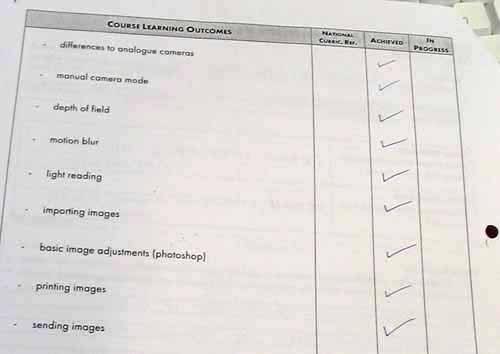
Knowing what I now know about the evils of Photoshop, I realise that you are just going to have to take my word for it that this is what the form I filled in looked like after I had filled it in. But do, for that is how it looked.
In my case the lies I told with ticks were so tiny as to be nigh on invisible, and reality immediately caught up with them. But I am told by others that often, when the boxes are all ticked, the lies told are monstrous. The ticks have no connection whatever with what really happened. But nothing but complication and confusion is caused by telling the truth on these forms by not ticking them in all the places where ticks go, and anyone who does is instantly self-branded as a trouble-maker.
Everyone in the system, from the lowliest school cleaner up to the Minister of Education, and on up to the very Prime Minister himself, knows that the information gathered in this manner has only a random relationship to the truth, but all agree to pretend that the ticks in the boxes do indeed describe reality.