
I claim no expertise in the whole exams-are-getting-easier debate. I merely suspect, like lots of others, that they are. But this does sound seriously ridiculous:
Pupils were awarded A grades in one of Britain's most popular GCSE maths exams this summer despite having only achieved half marks.Students needed to score just 45 per cent in two exams to achieve an A grade in an exam set by the Edexcel board. Combined with their coursework scores, this meant that just 51 per cent was needed overall.
The papers were sat by 80,000 pupils this summer and more than half got an A or A*. The figures were condemned as "ludicrous" by maths experts.
So, if you are concocting your CV, and you have GCSEs on it that are not Edexcel GCSEs, be sure to say so. On the other hand if they are Edexcels, keep quiet about it.

I say optimistic things about robots here from time to time, so here is some criticism of that approach to using computers.
Amazon quotes Publishers Weekly, re this book:
Hawkins designed the technical innovations that make handheld computers like the Palm Pilot ubiquitous. But he also has a lifelong passion for the mysteries of the brain, and he's convinced that artificial intelligence theorists are misguided in focusing on the limits of computational power rather than on the nature of human thought. He "pops the hood" of the neocortex and carefully articulates a theory of consciousness and intelligence that offers radical options for future researchers. "[T]he ability to make predictions about the future ... is the crux of intelligence," he argues. The predictions are based on accumulated memories, and Hawkins suggests that humanoid robotics, the attempt to build robots with humanlike bodies, will create machines that are more expensive and impractical than machines reproducing genuinely human-level processes such as complex-pattern analysis, which can be applied to speech recognition, weather analysis and smart cars. Hawkins presents his ideas, with help from New York Times science writer Blakeslee, in chatty, easy-to-grasp language that still respects the brain's technical complexity. He fully anticipates – even welcomes – the controversy he may provoke within the scientific community and admits that he might be wrong, even as he offers a checklist of potential discoveries that could prove him right. His engaging speculations are sure to win fans of authors like Steven Johnson and Daniel Dennett.
However, in my defence, I don't get excited about robots to educate because they will be super-intelligent. It's more that I surmise that they will make nice (and very cheap and parent-friendly) pets, and that tots may enjoy conversing with them, even if they are fairly dumb. Maybe even because they are fairly dumb.
I got to this via Instapundit, whom I am consulting a lot just now because I enjoy the Dan Rather thing so much.
Gratuitous picture …
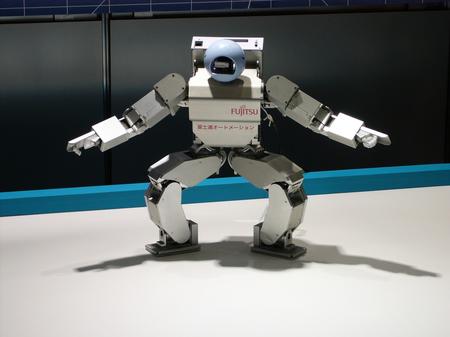
… of a Fujitsu Robot demonstrating its goal-keeping skills. I found this picture here.
(Actually, a goal-keeping robot sounds like a fantastic soccer training idea. Ideal for the obsessionally aspiring striker to hone his skills on, while also learning some technology management skills. Maybe this boy should be given one. (Idea for Ubersportingpundit posting. (I owe them something.)))
Further evidence of what children are capable of learning for themselves.
Literacy has to be taught, but the ability to use, and if necessary to invent, language is inborn. But, you have to do it young, or it doesn't work. Old people do not invent new languages.
Scientists have witnessed the birth of a new language, one invented by deaf children.A study published today shows that a sign language that emerged over two decades ago now counts as a true language.
It began in a school for the deaf in Managua, Nicaragua, founded in 1977. With instruction only in lip-reading and speaking Spanish, neither very successful, and no exposure to adult signing, the children were left to their own devices.
Their first pantomime-like gestures evolved into a grammar of increasing complexity as new children learned the signs and elaborated. Now it has a formal name: Nicaraguan Sign Language, (NSL), and is so distinct that it would not be understood by American and British signers.
David Carr comments at Samizdata.
Anthony Daniels (aka Theodore Dalrymple), now a regular contributor to the Social Affairs Unit Blog, says that young British blacks, or to be precise, young British Jamaicans, do badly at school not because of racism (the claim of a recent report – echoed by The Guardian) but because of the culture with which they have now surrounded themselves. Other racial minorities have thrived despite vicious racism against them. So what's with the Jamaicans?
If raw racial prejudice is not the explanation, then, what is the explanation? I think it is twofold. First, there is a marked lack of stability in the households of young blacks i.e. Jamaicans. This instability is seen in white lowest class households, of course, where it has precisely the same effects, except that the girls are less distinguishable from the boys, from the point of view of failure. Relative poverty does not in itself preclude constructive achievement among children, but when combined with a kaleidoscopically shifting spectrum of social pathology, it most certainly inhibits it.Perhaps even more important is the culture that the young Jamaicans have adopted for themselves, both in England and Jamaica. It is not exactly a culture that promotes high endeavour in fields such as mathematics, science or English composition, to put it mildly. It is a culture of perpetual spontaneity and immediate gratification, whose largely industrialised and passively consumed products are wholly worthless sub specie aeternitatis. The young Jamaican males may have been sold a bill of goods by an unscrupulous entertainment industry, purveying drivel to morons, but they have bought it with their eyes open. Seen from the outside, at least, this culture is one upon whose valuelessness no execration could be sufficiently heaped.
By refusing even to entertain cultural characteristics as a possible explanation of failure, the combined forces of the Mayor, his commission and The Guardian are in fact serving to enclose the Jamaican black males in the wretched world that they already know and that already encloses them. They are, in effect, saying to them that the fault is not with them, their tastes and the way they conduct themselves, but with society as a whole. They are condemning them to a world of violence, drugs and familial insecurity.
Teacher Jane Smith comments:
Anthony Daniels is spot on – I have taught in London schools and his argument about Jamaican youth culture fits my own experiences. Teachers are however unwilling to say this publicly for fear of being branded racists. A problem which Daniels does not highlight is the fear that teachers have that parents will play the racism card if their children are put in detention or do badly at school. Thank you for an excellent article.
Comments from teachers (and from current pupils come to that) count at least twice here.
 More Tsardom:
The Government today appointed a new maths "Tsar" tasked with turning around years of decline in the subject.Celia Hoyles, who starts her job as chief mathematics adviser next month, will "champion" the subject at all levels, from primary schools to university and beyond.
Education Secretary Charles Clarke said the appointment of Prof Hoyles was "critical" to revitalising maths education.
England is short of about 3,500 maths teachers, equivalent to more than one for every comprehensive in the country, a major inquiry found earlier this year.
Students, teachers and employers were all being let down by the current system, according to Professor Adrian Smith’s Government-backed inquiry into post-14 maths.
Mr Clarke said he was "delighted" with the appointment of Prof Hoyles, who is currently working at the University of London's Institute of Education.
"I believe this appointment is critical to the success of the mathematics strategy we outlined earlier this year," he said.
"The road ahead will be filled with opportunities to revitalise the study of mathematics and raise the profile of mathematics for everyone, not just pupils in schools and their teachers."
Prof Hoyles said: "I am thrilled to accept the role of chief adviser for mathematics, and look forward to the challenges ahead."
You get the strong feeling, don't you, what with all the "sneer quotes", that the writer of this report detected an air of false optimism about the show that was laid on in front of him. "Delighted". "Filled with opportunities". "Thrilled". Above all there is that gruesome word "challenge", which means insoluble difficulties of all kinds.
The original idea of a Tsar was that there was only one of him, and his word was law. But what happens when two Tsars bump into each other in a government corridor, both chasing the same money, or demanding the same slice of the school day or of the National Curriculum? Who wins? And what happens when the Tsar comes up against, you know, the Minister of Education?
Last time I was in touch with her family, the news of Goddaughter II was that she is hoping to get to Chetham's School of Music, on the back of her cello playing, which is apparently improving fast.
The great thing about Chetham's is that (a) it produces lots of excellent musicians, and,(b) just as vital, it produces lots of excellent non-musicians, people who excelled at music when they were kids, but who then went on to do other things in later life, with equal enthusiasm and distinction. Chetham's supplies great music education, and great non-music education. No wonder Goddaughter II's family are so keen on her to try to get there. Hope she does it. Even if she doesn't, the attempt will stretch her in all the right ways, I think. (I hope.)
And now here is another story, this time culled from googling about strangers, of a kid with one great talent, who is about to have his education built around that.
Spanish football giants Real Madrid have added a seven-year-old boy from Brighton to their ranks of superstars.Niall Mason impressed Real at a two-week summer course at the club so much that they asked him to join their prestigious Escuela Deportivo de Futbol Federation Madrid.
He becomes the latest English player on Real's books following the signings of David Beckham, Michael Owen and Jonathan Woodgate.
Niall will train twice a week for eight months at the academy with his schooling continuing at a local English school.
The Mason family, including his mother Mimosa, father Russell and three-year-old sister Maya, are all moving to Madrid where they will live in a flat close to Real's Bernabeu stadium.
Sounds like a somewhat Spanish family already, doesn't it? Well, good luck to them all.
Everything depends, with a story like this, on the way that the adults handle things. Do they bet everything on Niall becoming a soccer star, and then treat him, and make him treat himself, like a total failure if that doesn't work out? Or do they teach him soccer, and teach him the kind of things that a star institution like Real Madrid can teach him about life in general, and thereby prepare him well for whatever life may bring him.
I'm optimistic about Niall's chances. I don't think that Real would have gone to all this bother for Niall if they didn't like the look of his family background as well as his soccer skills. And I have enough respect for Real as educators ("Escuela Deportivo de Futbol Federation Madrid" sounds like they take all this pretty seriously), not only to hope that things will go well for Niall, but actually to think it, regardless of whether he ever makes it in big time soccer. Sorry: "Futbol".
Besides which, the Real futbol team may find themselves needing him quite soon.
Lew Rockwell writes about home schooling versus school schooling, and about phonics versus whole word literacy teaching.
Long-time readers may recall a column titled, "A Tale of 2 Children," wherein I compared two 3-year old children, one of whom was being taught to read by his parents and one who was destined for public school. The two children are now 5 years old, and I recently examined their progress.The child in kindergarten is not yet reading, but he has learned his complete alphabet now. The homeschooled child, on the other hand, surprised me by reading at an error-free fifth-grade level on the San Diego Quick Assessment test. I verified his competence by asking him to read selections from C.S. Lewis' "Prince Caspian" to me, a book with which he was previously unfamiliar. While he occasionally stumbled on words such as versification and centaur, (he pronounced them "versication" and "kentaur"), his comprehension was reasonably good as well.
Suddenly, it was not so hard to understand how homeschooled children, on the average, test four years ahead of their public-schooled counterparts.
The problem with public schools and reading is not hard to grasp. Whole language, the favored method, is a disastrous approach to reading that is destined for failure. Children who learn to read while being taught this method learn to read in spite of it, not because of it. …
Yes, that's how it seems to me also. Read more about the phonics method here.
By the way, every time I visit a phonics site, such as the one linked to above, I look for a step-by-step description of how to teach reading in the best phonics way possible. After all, these people are adamant that there is a best way. So what exactly is it? I want to have a how-to guide to read. First do this. Test it like this. Then do this. Test this like this. Then do this. Then do that. Practise it like so. Reinforce it like so. Learn to spell this list of words. And so on.
The trouble is, when I think I may have found such a guide, I either find I have to pay for it, which seems odd given that these people are trying to spread literacy and not just to make money. Or else I find myself reading yet another argument about why the method they favour is the best one, or, even more tangentially, why other methods are bad. Which is absolutely not the same thing as the best method itself. These arguments are important, and it is important that the best team wins them. But an explanation of why a method works is a quite distinct matter from the thing itself.
Can any of you phonics-persons help me? Please note that I will fisk you/it mercilessly if you merely show me yet another argument about why your particular brand of phonics works, or indeed any method which ever digresses into this related distraction. I want the thing itself, and nothing else. This must be available, to read and to link to, somewhere on the Internet. If it isn't, then it damn well ought to be.
Yes, that's what they say.
I try not to go on about America all the time, but this was too juicey a quote to ignore. Thank you Google for picking out that sentence.
Here's the paragraph it comes in:
And, while charter-school supporters point to other studies and anecdotal information to show that charter schools can work, vying studies don't demonstrate who is right and who is wrong. They simply demonstrate that the possibility for success of children in charter schools is an unknown. Our children's education is too important to try experiments to see what works best.
But if people are dissatisfied with what they are getting now, and if nobody is actually going to die or even suffer acute pain during these experiments, and might actually be a lot happier and learn more, then what's wrong with parents who want to giving them a go.
After all, there are a lot of public sector schools where parents would love it if the outcome was an "unknown", instead of the all-too-known that they are instead stuck with.
I think I know what these authors were trying to say with this amazing sentence, but the words they actually used show, I think, how out of touch they must surely be with lots of parents. They've said things like this to their friends and co-educrats so often, to such warm applause, that they truly didn't realise what they'd put. When they talk or write about "experiments", they, and their usual audiences and readerships, see evil right wing monsters inflicting cruel tortures on furry white animals and chucking defenceless kids off an experimental cliff. But lots of others will simply see them turning their backs on the obvious way (experiments) to make progress and to add to the store of human knowledge, in this case to the knowledge of how best to impart knowledge to the next generation.
I have already reported on Gems, the Dubai-based private education supplier. Here is more, today, from thisislondon.co.uk:
WE have budget airlines and hotels – and now the 'no-frills' public school. 'Economy class' education could become a feature of the British landscape with the emergence of a new kind of independent school.Dubai-based company Global Education Management Systems (Gems) is planning to open 200 schools charging from £5,000 to £10,000 a year depending on the class sizes and facilities on offer.
The schools may not boast grand settings like Eton, Harrow and Winchester - where fees are up to £20,000 a year – but the company claims they will be a good, affordable alternative to State education.
I didn't get that Gems were "planning" (whatever that may mean) anything so ambitious as this. Well, I do now.
And this report continues:
Meanwhile, the think-tank Civitas, which believes more parents would opt for private education if they could afford it, has hit upon a similar idea.Today it opens a public school in a rented room at a sports centre in Queen's Park, North West London.
The New Model School has just one class - reception year - and charges £900 a term. It will expand each year until these pupils reach 18 years of age. Civitas hopes to create a chain of low-cost schools.Former schools inspector Mike Tomlinson has welcomed no-frills schools. But a spokesman for the Independent Schools Council said last night standards might suffer.
Maybe. But the business of the higher cost suppliers might also suffer. Keep your ears open for the phrase "educational cowboys".
Britain might finally be getting Tesco education. Well, Sainsbury education, maybe. Or perhaps "EasySchool". Check out this new school here. And here is the Gems website.
My thanks to Helen for the phone call that got me googling for this.
Education as a global industry proceeds inexorably.
Singapore is selling education to Indians:
NEW DELHI – Affordable fees. Global curricula and world-class faculties. Close to home. A 'safe mix' of the best from the West and the East.These are among the advantages Singapore offers Indian students as it positions itself to be Asia's education hub.
With these advantages, Singapore is a better option than even the United States, according to some parents and students who visited a two-day roadshow that ended here yesterday.
And Dubai is selling education to Scotland (although in this case "Dubai" sounds more like a flag of convenience):
A DUBAI-based company that claims to provide "no frills" private education is to open its first school in Scotland next year.Global Education Management Systems (Gems) charges fees of £5,000 a year, up to half the cost of a traditional private school. It already has acquired 13 schools south of the border and is now carrying out market research with a view to expanding into Scotland. Its aim is to become the biggest provider of private education in the UK within the next five years.
In the Gulf states, about 40,000 children are currently educated in Gems schools, which are geared to providing high teaching standards rather than luxurious surroundings and facilities.
Sunny Varkey, an Indian entrepreneur who recently signed a deal to take his chain into Afghanistan, heads the Gems group. He plans to use Gems’ position as a limited company to invest in school facilities, claiming it will give him an edge over most independent schools, which find it difficult to raise money for new buildings due to their charitable status.
A spokeswoman for Gems said it had conducted market research and found that there was demand in Scotland for their schools. She added: "It's our intention to expand right across the whole of the UK. We are moving north of the border. I would say, realistically, it will be about a year but if a plot of land came up, it could be much sooner than that."
There's no business like global ed-business.
Mark Holland has been out and about, biking if it's fine, windsurfing if it's wet, and on his travels he encountered some students, studying:
Also out on the water today were a flotilla of mostly learner kayakers mixed in with a few who knew their stuff.Speaking to a couple of them afterwards I learnt that they are at the local uni studying for a BA Honours Degree in Adventure Education. I didn't laugh honest. In fact I'm rather jealous. …
I'm not. This is my idea of hell on earth. But, each to his own.

Michael Brooke comments:
My degree - Business Studies with a focus on arts management - had a couple of compulsory terms of Leisure Studies, which wasn't anything like as relaxing as its title suggests.It turned out to be surprisingly fascinating, though, drawing on history, culture, politics, sociology and technology (cheap air travel, television, the internet) to examine the changing ways in which we've made use of our leisure time and how our attitudes towards it have differed.
I've recently taken a holiday, which I have spent entirely on chucking stuff out and organising what remains, nesting in other words. Very satisfying.
I did a piece for here today, about graduates having a tough time getting jobs, and at the last moment I realised it would do just as well onto Samizdata. So there it is, and the comments are piling up interestingly.