Brian Micklethwait's Blog
In which I continue to seek part time employment as the ruler of the world.
Homewww.google.co.uk
Recent Comments
-
Brian Micklethwait on Jamie Hannah's new video
-
6000 on Jamie Hannah's new video
-
Michael Jennings on Four Channel Islands and a fifth Channel Island
-
Brian Micklethwait on Tulip approved
-
Michael Jennings on Tulip approved
-
Brian Micklethwait on A new (remote) control tower for City Airport
-
Michael Jennings on A new (remote) control tower for City Airport
-
jack whiteley on Food photo
-
Cynthia Coleman on Spring in the air
-
Brian Micklethwait on New Big Thin Things in New York
Monthly Archives
-
May 2019
April 2019
March 2019
February 2019
January 2019
December 2018
November 2018
October 2018
September 2018
August 2018
July 2018
June 2018
May 2018
April 2018
March 2018
February 2018
January 2018
December 2017
November 2017
October 2017
September 2017
August 2017
July 2017
June 2017
May 2017
April 2017
March 2017
February 2017
January 2017
December 2016
November 2016
October 2016
September 2016
August 2016
July 2016
June 2016
May 2016
April 2016
March 2016
February 2016
January 2016
December 2015
November 2015
October 2015
September 2015
August 2015
July 2015
June 2015
May 2015
April 2015
March 2015
February 2015
January 2015
December 2014
November 2014
October 2014
September 2014
August 2014
July 2014
June 2014
May 2014
April 2014
March 2014
February 2014
January 2014
December 2013
November 2013
October 2013
September 2013
August 2013
July 2013
June 2013
May 2013
April 2013
March 2013
February 2013
January 2013
December 2012
November 2012
October 2012
September 2012
August 2012
July 2012
June 2012
May 2012
April 2012
March 2012
February 2012
January 2012
December 2011
November 2011
October 2011
September 2011
August 2011
July 2011
June 2011
May 2011
April 2011
March 2011
February 2011
January 2011
December 2010
November 2010
October 2010
September 2010
August 2010
July 2010
June 2010
May 2010
April 2010
March 2010
February 2010
January 2010
December 2009
November 2009
October 2009
September 2009
August 2009
June 2009
May 2009
April 2009
March 2009
February 2009
January 2009
December 2008
November 2008
October 2008
September 2008
August 2008
July 2008
June 2008
May 2008
April 2008
March 2008
February 2008
January 2008
December 2007
November 2007
October 2007
September 2007
June 2007
May 2007
April 2007
March 2007
February 2007
January 2007
December 2006
November 2006
October 2006
September 2006
August 2006
July 2006
June 2006
May 2006
April 2006
March 2006
February 2006
January 2006
December 2005
November 2005
October 2005
September 2005
August 2005
July 2005
June 2005
Most recent entries
- Brian Micklethwait’s New Blog starts now
- Now you see it now you don’t â then you do again
- Quimper Cathedral photos from a year ago
- Another symptom of getting old
- Quota photo of a signpost
- Three professional Japanese footballers play against one hundred children
- Sculptures and scaffolding
- There is no day that can’t be improved by seeing pictures of how they weigh an owl
- Meeting Oscar again
- A musical metaphor is developed
- Mobile phone photoing in 2004
- France is big
- Pink windscreen
- Just kidding
- Capitalism and socialism in tweets
Other Blogs I write for
Brian Micklethwait's Education Blog
CNE Competition
CNE Intellectual Property
Samizdata
Transport Blog
Blogroll
2 Blowhards
6000 Miles from Civilisation
A Decent Muesli
Adloyada
Adventures in Capitalism
Alan Little
Albion's Seedling
Alex Ross: The Rest Is Noise
Alex Singleton
AngloAustria
Another Food Blog
Antoine Clarke
Antoine Clarke's Election Watch
Armed and Dangerous
Art Of The State Blog
Biased BBC
Bishop Hill
BLDG BLOG
Bloggers Blog
Blognor Regis
Blowing Smoke
Boatang & Demetriou
Boing Boing
Boris Johnson
Brazen Careerist
Bryan Appleyard
Burning Our Money
Cafe Hayek
Cato@Liberty
Charlie's Diary
Chase me ladies, I'm in the cavalry
Chicago Boyz
China Law Blog
Cicero's Songs
City Comforts
Civilian Gun Self-Defense Blog
Clay Shirky
Climate Resistance
Climate Skeptic
Coffee & Complexity
Coffee House
Communities Dominate Brands
Confused of Calcutta
Conservative Party Reptile
Contra Niche
Contrary Brin
Counting Cats in Zanzibar
СкÑипÑÑÐ°Ñ Ð±ÐµÑедка
CrozierVision
Dave Barry
Davids Medienkritik
David Thompson
Deleted by tomorrow
deputydog
diamond geezer
Dilbert.Blog
Dizzy Thinks
Dodgeblogium
Don't Hold Your Breath
Douglas Carswell Blog
dropsafe
Dr Robert Lefever
Dr. Weevil
ecomyths
engadget
Englands Freedome, Souldiers Rights
English Cut
English Russia
EU Referendum
Ezra Levant
Everything I Say is Right
Fat Man on a Keyboard
Ferraris for all
Flickr blog
Freeborn John
Freedom and Whisky
From The Barrel of a Gun
ft.com/maverecon
Fugitive Ink
Future Perfect
FuturePundit
Gaping Void
Garnerblog
Gates of Vienna
Gizmodo
Global Warming Politics
Greg Mankiw's Blog
Guido Fawkes' blog
HE&OS
Here Comes Everybody
Hit & Run
House of Dumb
Iain Dale's Diary
Ideas
Idiot Toys
IMAO
Indexed
India Uncut
Instapundit
Intermezzo
Jackie Danicki
James Delingpole
James Fallows
Jeffrey Archer's Official Blog
Jessica Duchen's classical music blog
Jihad Watch
Joanne Jacobs
Johan Norberg
John Redwood
Jonathan's Photoblog
Kristine Lowe
Laissez Faire Books
Languagehat
Last of the Few
Lessig Blog
Libertarian Alliance: Blog
Liberty Alone
Liberty Dad - a World Without Dictators
Lib on the United Kingdom
Little Man, What Now?
listen missy
Loic Le Meur Blog
L'Ombre de l'Olivier
London Daily Photo
Londonist
Mad Housewife
Mangan's Miscellany
Marginal Revolution
Mark Wadsworth
Media Influencer
Melanie Phillips
Metamagician and the Hellfire Club
Michael Jennings
Michael J. Totten's Middle East Journal
Mick Hartley
More Than Mind Games
mr eugenides
Mutualist Blog: Free Market Anti-Capitalism
My Boyfriend Is A Twat
My Other Stuff
Natalie Solent
Nation of Shopkeepers
Neatorama
neo-neocon
Never Trust a Hippy
NO2ID NewsBlog
Non Diet Weight Loss
Normblog
Nurses for Reform blog
Obnoxio The Clown
Oddity Central
Oliver Kamm
On an Overgrown Path
One Man & His Blog
Owlthoughts of a peripatetic pedant
Oxford Libertarian Society /blog
Patri's Peripatetic Peregrinations
phosita
Picking Losers
Pigeon Blog
Police Inspector Blog
PooterGeek
Power Line
Private Sector Development blog
Public Interest.co.uk
Publius Pundit
Quotulatiousness
Rachel Lucas
RealClimate
Remember I'm the Bloody Architect
Rob's Blog
Sandow
Scrappleface
Setting The World To Rights
Shane Greer
Shanghaiist
SimonHewittJones.com The Violin Blog
Sinclair's Musings
Slipped Disc
Sky Watching My World
Social Affairs Unit
Squander Two Blog
Stephen Fry
Stuff White People Like
Stumbling and Mumbling
Style Bubble
Sunset Gun
Survival Arts
Susan Hill
Teblog
Techdirt
Technology Liberation Front
The Adam Smith Institute Blog
The Agitator
The AntRant
The Becker-Posner Blog
The Belgravia Dispatch
The Belmont Club
The Big Blog Company
The Big Picture
the blog of dave cole
The Corridor of Uncertainty (a Cricket blog)
The Croydonian
The Daily Ablution
The Devil's Advocate
The Devil's Kitchen
The Dissident Frogman
The Distributed Republic
The Early Days of a Better Nation
The Examined Life
The Filter^
The Fly Bottle
The Freeway to Serfdom
The Future of Music
The Futurist
The Happiness Project
The Jarndyce Blog
The London Fog
The Long Tail
The Lumber Room
The Online Photographer
The Only Winning Move
The Policeman's Blog
The Road to Surfdom
The Sharpener
The Speculist
The Surfer
The Wedding Photography Blog
The Welfare State We're In
things magazine
TigerHawk
Tim Blair
Tim Harford
Tim Worstall
tomgpalmer.com
tompeters!
Transterrestrial Musings
UK Commentators - Laban Tall's Blog
UK Libertarian Party
Unqualified Offerings
Violins and Starships
Virginia Postrel
Vodkapundit
WebUrbanist
we make money not art
What Do I Know?
What's Up With That?
Where the grass is greener
White Sun of the Desert
Why Evolution Is True
Your Freedom and Ours
Websites
-
Answers.com
Arts & Letters Daily
archive.org
Arts Journal
b3ta
Bjørn Stærk's homepage
Brussels Journal
Butterflies and Wheels
Cato Institute
City Journal
Civitas
Clivejames.com
Comment Central
Commentary
Cricinfo
Daniel Barenboim
Dark Roasted Blend
Democratiya
Digital Photography Review
ECB
FaithFreedom.org
Flickr
Frikoo
FrontPageMag.com
galinsky
Ghana Centre for Democratic Reform
Global Warming and the Climate
History According to Bob
Howstat
Imani
InstaPatrick
Institut économique Molinari
Institute of Economic Affairs
Lebrecht Weekly
Libertarian Alliance
LiveScience
Ludwig von Mises Institute
Mark Steyn
Oxford Libertarian Society
Pajamas Media
Paul Graham
Sean Gabb
Signal100
Soundstage Communications
Stockholm Network
Syed Kamall
Technology Review
TED
The Christopher Hitchens Web
The Inquirer
The Register
The Space Review
The TaxPayers' Alliance
This is Local London
Toccata Classics
UK Libertarian Party
Victor Davis Hanson
WSJ.com Opinion Journal
YaleGlobal Online
YouTube
Mainstream Media
BBC
Guardian
Economist
Independent
MSNBC
Telegraph
The Sun
This is London
Times
Syndicate
RSS 1.0
RSS 2.0
Atom
Feedburner
Podcasts
Categories
Advertising
Africa
Anglosphere
Architecture
Art
Asia
Atheism
Australasia
Billion Monkeys
Bits from books
Bloggers and blogging
Books
Brian Micklethwait podcasts
Brians
Bridges
Business
Career counselling
Cartoons
Cats and kittens
China
Civil liberties
Classical music
Comedy
Comments
Computer graphics
Cranes
Crime
Current events
Democracy
Design
Digital photographers
Drones
Economics
Education
Emmanuel Todd
Environment
Europe
Expression Engine
Family
Food and drink
France
Friends
Getting old
Globalisation
Healthcare
History
How the mind works
India
Intellectual property
Japan
Kevin Dowd
Language
Latin America
Law
Libertarianism
Links
Literature
London
Media and journalism
Middle East and Islam
Movies
Music
My blog ruins
My photographs
Open Source
Opera
Other creatures
Painting
Photography
Podcasting
Poetry
Politics
Pop music
Propaganda
Quote unquote
Radio
Religion
Roof clutter
Russia
Scaffolding
Science
Science fiction
Sculpture
Signs and notices
Social Media
Society
Software
South America
Space
Sport
Technology
Television
The internet
The Micklethwait Clock
Theatre
This and that
This blog
Transport
Travel
USA
Video
War
Category archive: Software
But it does very well without one.
Video here.
I’ve included “War” in the category list below, because the battlefield is surely one of the places where these contraptions will make their creepy presence particularly felt.
This is definitely my favourite Other creatures story of recent months. Months because this was reported on before Christmas, and I’ve only just got around to mentioning it here.
Parrot used Amazon Alexa to order items while his owner was away:
So far Rocco the African Grey, from Didcot, Oxfordshire, U.K., has demanded treats such as strawberries, watermelon, raisins, broccoli and ice cream.
He has also ordered a kite, light bulbs and even a kettle.
Rocco likes to dance too and tells the voice-activated device to play favorite tunes. Sometimes they are slow numbers, but he generally prefers rock.
Where is voice recognition when you need it?
Alexa needs a setting, for junior members of a household, for whom she is allowed to play musical requests, but from whom she is not allowed to take purchase orders.
You’d think that with lots of kids in the world, many causing havoc, Alexa would be able to make the necessary distinctions. But it sure is entertaining when she doesn’t.
I basically picked last night’s quota photo for alliterative reasons. QUota. QUantum. As we bloggers say: heh. No long essay was required to present that little joke, if joke it even was.
In the course of my search late last night for a suitable QP, I came across other photos which seemed suitable for showing here, but which demanded little essays to explain what it was that made them suitable. And I was too knackered for that, having spent yesterday working on this talk for Christian Michel’s 6/20 soiree, and then in the evening giving the talk.
In particular, late last night, I encountered in my photo-archives this remarkable (I think) photo, which I took in Regent’s Park in March of 2012, as it was getting dark, when on my way back from taking photos on and from Primrose Hill:
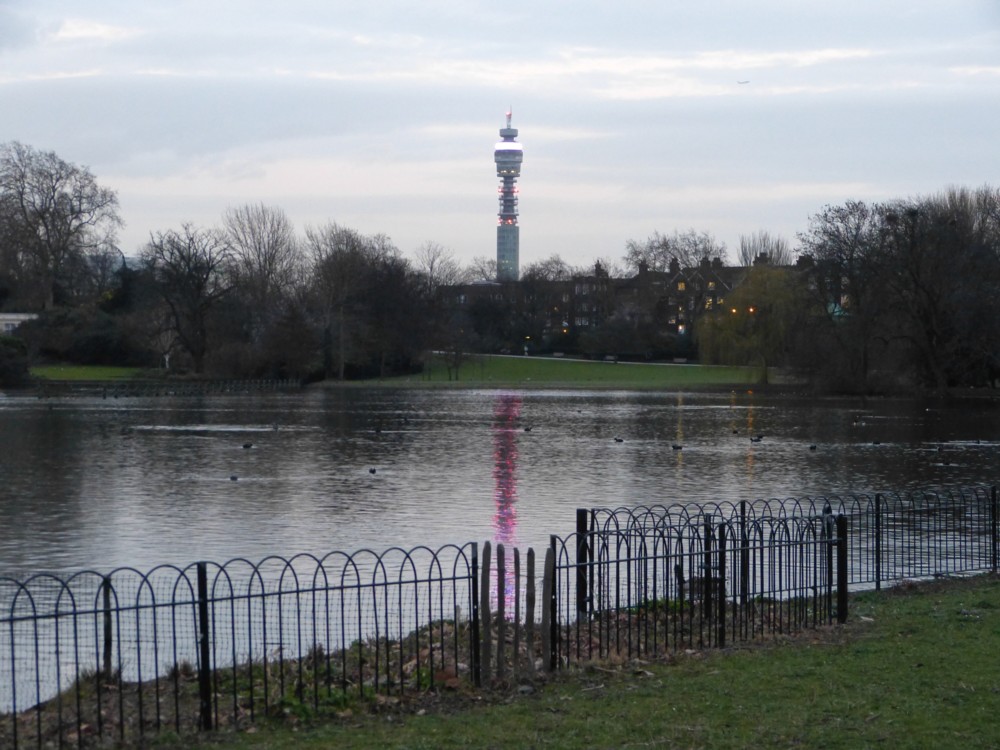
What I find remarkable about that photo is the contrast between how very red the reflection in the water of the lights on the BT Tower is, compared with how very un-red the actual lights themselves are, as photoed through the mere air.
You often get this with reflections. In photos, I mean. Your actual eyes make adjustments as they scan the scene. What I would have seen, with my eyes, when photoing the above photo, is quite bright red lights on the tower, and a similarly bright reflection.
But my camera, on automatic, doesn’t think like this. All my camera is concerned about is the overall balance. It has to pick just one balance and apply it to everything. And because a reflection is involved, it often ends up picking a balance where the actual view is very light and bright, but the reflection contains all the action. I often do this-and-this-same-thing-relected photos with a glass window doing the reflecting. And often what you get with that is a completely blank white sky, but then in the reflection you get all the distinctions between quite light and not so light, quite blue and not so blue, that you don’t get in the bit of the photo that is directly of the sky.
And that’s what surely happened with the above photo. The redness got lost when we were just looking at the lights themselves. But the water darkened and strengthened that same redness, and made it really red.
On the day, I was more interested in the birds swimming around on the water. The next eight photos in that directory are of ducks and geese, and the final three are of a swan. After that I called it a day, what with daylight having ended. I only really noticed this reflected redness thing last night.
Most Real Photographers have to have the skill of knowing at once when they’ve photoed a good photo, and why. We unreal photoers can take our time.
During our recent chat about transport (already mentioned her), Patrick and I talked about robot cars. I expressed particular skepticism about their supposedly forthcoming arrival en masse on the roads of our cities. We mentioned, in contrast to the idea of robot cars immediately conquering our cities, the fact that robot vehicles are already in successful operation in certain niche situations. We were able to think of two such. They already use giant robot lorries in the mining industry. And, Amazon already has robots wizzing about in its warehouses. Both environments have in common that they are wholly owned by the operator of the robots, so if the humans in the place need to learn the habits of these robots and to give them whatever assistance and whatever slack the robots need, then such humans can simply be commanded to do this. Unlike in big cities.
More recently, I met up again (as in: more recently than that meeting), with Bruce the Real Photographer, and mentioned that Patrick and I had been doing recorded chats, mentioning in particular our robotic ruminations. And Bruce then told me about another niche use that robot vehicles have apparently been occupying for quite some time time now. It seems that in Spain, a country that Bruce knows very well, the tyre company Michelin has a big testing track, and on this track, robot vehicles drive around and around, testing Michelin tyres.
You can see how this would make sense. The robots can travel at exactly the desired speed, along a precisely preordained route, and thereby, say, subject two only slightly different sets of tyres to the exact same “driving experience”, if you get my drift. Getting humans to perform such perfect comparisons would be very difficult, but this is exactly the kind of task, and in general the kind of operation, where robot vehicles would be ideal. And, reports Bruce The Real Photographer, they are ideal.
Me having just written all that, I wonder if Google has anything to say about this Michelin testing operation. Not a lot, it would seem. They are far keener to sell their tyres than to tell us the details of how they test them, which makes sense. But, this bit of video seems like it could be relevant. And this â¦:
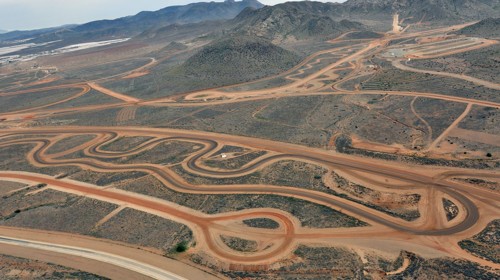
... would appear to be the particular place that Bruce mentioned, because he recently tried - I don’t recall him saying why â but failed to get in there and see it. To take Real Photographs perhaps?
And here is another bit of video about how Bridgestone is using robot vehicles to check out tyre noise.
So, testing vehicle components. An ideal job for robot vehicles. Robots are very precise. They don’t get tired. And you can use a special track where all the humans involved are on their best behaviour.
With blogging, excellence is the enemy of adequacy, and often what you think will be excellence turns out not to be.
Eight days ago now, Patrick Crozier and I had one of our occasional recorded chats, about transport this time. Train privatisation, high speed trains and maglevs, robot cars, that kind of thing. I think it was one of our better ones. We both had things we wanted to say that were worth saying, and both said them well, I think. Patrick then did the editing and posting on the www of this chat in double quick time, and I could have given it a plug here a week ago. If I have more to say about transport, I can easily do other postings. But, I had some stupid idea about including a picture, and some other stuff, which would all take far too long, and the simple thing of supplying the link to this chat here was postponed, and kept on being postponed.
Usually, this kind of thing doesn’t matter. So, I postpone telling you what I think about something. Boo hoo. But this time I really should have done better.
There. All that took about one minute to write. I could have done this far sooner. Apologies.
This makes sense:
There are three separate things the larger Twitter user base demands from the company:
- the ability to send messages out to the entire world
- the ability to interact with fellow users
- the ability to send messages without the fear of toxic responses
The problem is it’s basically impossible to guarantee all three at once. Call it the “Twitter impossibility theorem,” to ape Kenneth Arrow. You can have an open Twitter, you can have an interactive Twitter, and you can have a troll-free Twitter, but it is basically impossible to have all three. One of the demands must be dropped.
Twitter reminds me of that fish in The Hitchhiker’s Guide, which jumps into your ear and translates all the languages of the gallaxy into your language, which started wars because it meant that everyone could understand what you had said, and hate it, and be understood by you hating it.
Twitter doesn’t translate, but it connects the hitherto unconnected.
In this:
Apple, Microsoft, Amazon, Google and Facebook have a combined market capitalization of $3.7 trillion, equal to Germany’s gross domestic product last year.
Quoted at Instpundit by Stephen Green, who says that this is an “incredible figure”. It certainly is very big, if that’s what “incredible” means, when you are describing a very big number.
Again with the maybe-betrayed-confidence-but-I-hardly-think-so routine. Michael Jennings tells me and whoever else he told, on Facebook, that he liked this Forbes piece, about how Digital Currencies And Credit Cards Have Subways To Thank For Their Existence.
Quote:
The following century ...
⦠i.e. the twentieth century â¦
… saw an explosion in urban populations, and a requisite growth in the worldâs railway network, but this was not accompanied by a substantial changes in the world of ticketing. Manually-operated entry gates to train stations had slowly become more common, but most public transport passengers continued to rely on bits of paper â or occasionally, metal tokens â to get around their city.
In 1950s London, this was starting to cause problems. The Tube network was bigger and busier than ever, which prompted operators to consider installing automated gates, like those in NYC. “We knew that this would help ease congestion, but it was complicated by the fact that London has always had fares based on distance,” Shashi Verma, Chief Technology Officer of Transport for London (TfL), told me, “Standard metal tokens weren’t an option.” So, the then-named London Transit Authority started looking at alternatives. The result, which was released to the world in 1964, was the printed magnetic stripe. The idea of using magnetism to store information had been around since the late 1800s, and magnetic tape was patented in 1928 by audio engineer Fritz Pfeulmer. But transport was its very first ‘real-world’ application. A full decade before the now-ubiquitous black/brown magnetic stripe was added to a single bank card, it was printed onto millions of tickets for the London Underground.
I miss Transport Blog. The old link to it no longer works, and it would appear that it is no more.
Sorry about yesterday here. All now seems to be well.
Sadly, this SQL error crap seems to keep happening. Although as of now I promise nothing, a better answer than just correcting such things when they happen is now being worked on.
I like this, in an I wouldn’t actually want one sort of a way::

But it isn’t a serious piece of furniture. Nobody is actually going to buy one of these edifices. If that’s wrong, I look forward to learning about it and telling you about it, with more photos, of this 3 decker sofa in an actual home type home, instead of in something that looks like a city office.
The idea is, I assume, to flood the internet with the set of pictures of which the above is but one, of this cross between a sofa and a sports stadium, and thereby get people to link to stories like this one, which are about some kind of joint venture between BT (which stands for British Telecom) and EE (which stands for Esomething Esomething), involving being able to shove whatever television stuff you are receiving on your mobile phone onto your television. At no extra charge, blah blah, which always actually means at a definite extra charge. (EE probably began life meaning Extremely Expensive. Something to do with mobile internet connections, I think.)
For me, what this sofa-sports-stand is about is the fact that domestic television is getting steadily bigger and better, and cinemas and pubs are get steadily less attractive as places to watch ⦠video. This is the trend that EE/BT are tuning into, to sell whatever it is they’re selling.
The key moment in this process was when big TVs started getting cheap.
Indeed:
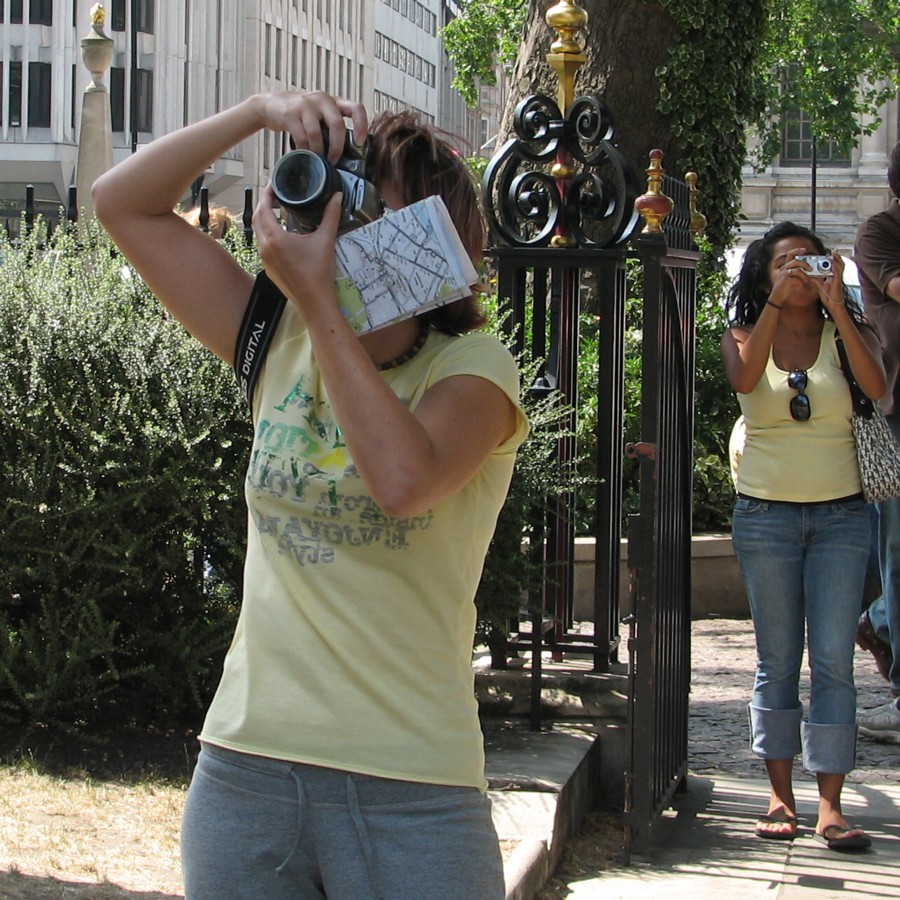
That photo was taken (by me (near Westminster Abbey)) in July 2006. You never see people clutching street maps like that now. All such maps now are smartphone maps.
Today is Friday, which used to be my day for cat stories but is now also the day here for creatures of other sorts. But for old times sake, I just got google to tell me some cat news, having had a busy day and not having any recently encountered creature stories of my own to muse upon.
And without doubt, the most intriguing yarns google told me about were these ones, published by cryptoslate.com:
How Two Guys Made $100k Trading Digital Cats on Ethereum, Merit of Digital Collectibles
CryptoKitties Keeps With Ethereum and Goes Open-Source
Millions of Dollars Worth of Cats are Still Infesting the Ethereum Network
The last paragraph of the last of these three stories goes thus:
While CryptoKitties may sound laughable to some, the exuberant on-boarding of Ethereum is sending positive signals around the network. And in fact, CryptoKitties now accounts for around 4% of all Ethereum transactions; it’s the second most used application on the network. CryptoKitties definitely proves there is definitely market for rare, fungible, digital assets that are traded and exchanged on the blockchain.
Definitely.
Using phone. Impossible. That is all.
LATER: Well, not quite. It seems that it was Google not working. Or something. Everything went black. Why? So after all the usual switch-it-off-switch-in-on-again bollocks, I closed all windows, black as they were and were determined to remain, and then opened just one. And that, this, worked. I found out google wasn’t working by trying another internet searcher thingy. That worked. Except that it couldn’t remember how to get here, if it ever knew. So, I closed google and opened it again, a little.
Very peculiar.
As for that using phone thing, well, again, not impossible. Just ridiculously difficult.
Next Friday, my good friend Adriana Lukas will be giving a talk at my home entitled Personal Recollections of Life Under Communism. While concocting some biographical information for my email list members, I took a closer look than I have before at her Twitter feed.
Way back in 2015, Adriana retweeted this remarkable image:
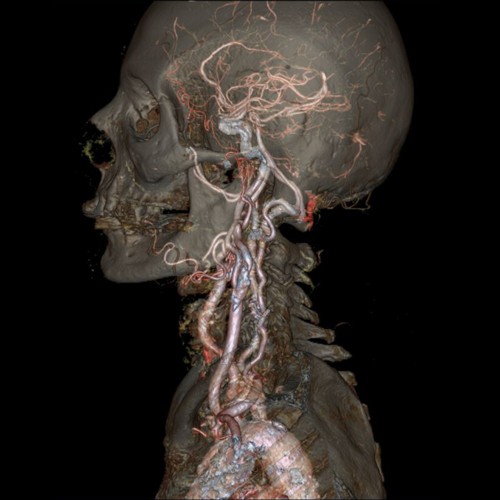
It looks like some ancient oil painting, rather than the latest-thing highest-of-high-tech imagery, which of course is what it is.
GE Healthcareâs 3D-printing software works seamlessly with GE Advantage Workstation systems already working inside hospitals around the world. After a scan, the anatomy is rendered as a 3D image using GEâs Volume Viewer software, a 3D-imaging platform that combines data from sources like CT but also MRI and X-ray. The software then converts the image file generated by the Volume Viewer and within seconds translates it into a file format that can be interpreted by a 3D printer.
“In the past, it would take several days to get the images back” from an outside 3D software processor, Cury says. “The advantage of the new software is it’s in the same workstation where the technologists already do work on 3D images. The steps are a lot quicker and easier.”
More than 100 hospitals around the world have already ordered GE’s 3D organ printing software, which can be used for any type of organ as well as models of bones and muscles. GE says that as more hospitals use the software, it will be easier and quicker for doctors like Cury to share files with each other and have 3D models to use for planning and education prior to procedures.
The most impressive 3D printing stories often feature hopelessly old-school businesses, like GE. This is because 3D printing is the ultimate non-disruptive technology. It attaches itself to existing businesses and makes them better. If you know only about 3D printing, and are not willing to cooperate with a regular business, forget about it.
All those stupid 3D printers that they tried to sell in Currys PC World a few years back were just ridiculous junk for making further even more ridiculous junk.
Today, I connected my camera to someone else’s Mac. But clicking through the photos on my camera proved impossible, the way I find this to be trivially easy on my clunky old PC with clunky old Windows. We could not make this work. Which just goes to prove that ancient computer truth. There is no such thing as “user friendliness”. There is only what you know how to make a computer do, which is trivially easy, and what you do not know how to make a computer do, which is impossible.
See you tomorrow. Maybe only as briefly as this. Or maybe not see you tomorrow at all.